

Disclaimer: This post is for entertainment only and is not financial advice. See full legal disclaimers here.
In 2026, Pokémon is releasing the First Partner Illustration Collection in the U.S., a promo-card product built around the starter Pokémon from across the franchise. Each box contains three illustration-style promo cards. Each series contains nine total promos to collect. Across all three series, the full English promo lineup is 27 cards.
The boxes launched at a $14.99 MSRP, meaning a nine-card series could theoretically be completed for $45 at retail if you could buy the exact three boxes you needed. That is extremely affordable compared to modern chase cards that can require hundreds or thousands of packs to pull one.
But the market is not treating these like ordinary $14.99 collection boxes. Series 1 boxes have been selling far above MSRP on the secondary market. Complete PSA 10 sets of the first nine promos have sold for extremely strong prices in early auctions. And when Series 2 released, I went to Target and saw a line out the door. That is not normal for a random promo product.
For collectors and investors, this kind of demand matters. This article breaks down what the First Partner Illustration Collection promos are, how the release works, what cards are included, and what the early market is doing.
What are the 2026 Pokémon First Partner Illustration Collection promos?
The 2026 Pokémon First Partner Illustration Collection promos are a U.S. promo-card release built around the starter Pokémon from across the Pokémon franchise. In Pokémon’s terminology, a “first partner” is the Pokémon a player chooses at the beginning of a game. Most collectors simply call them starter Pokémon.
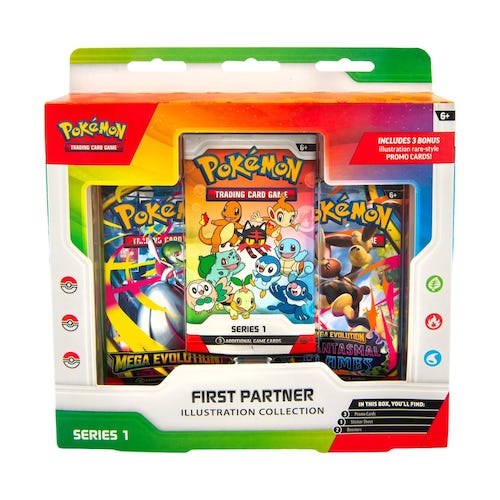
The full English promo lineup includes 27 cards total, divided into three separate series. Each series contains nine promos. The important thing to understand is that you do NOT get all nine promos in one box. Each box gives you one regional trio.
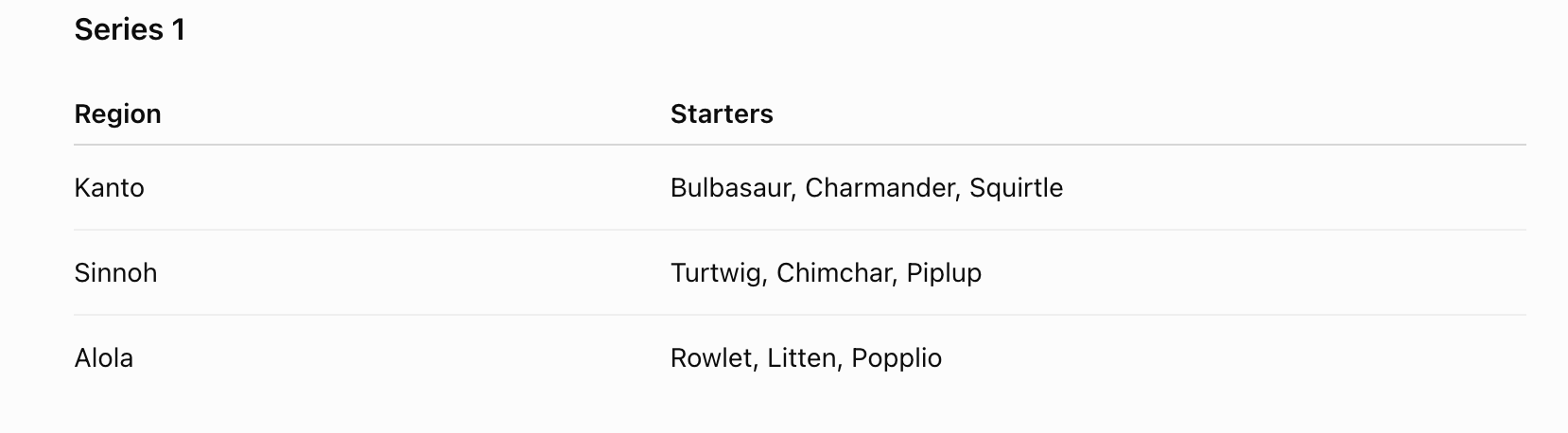
For example, a Series 1 box can contain one of three possible trios:
Bulbasaur, Charmander, and Squirtle
Turtwig, Chimchar, and Piplup
Rowlet, Litten, and Popplio
That blind regional mechanic is part of what makes the product interesting. You are not just buying a fixed promo box. You are buying a chance at one of the regional trios, and some trios clearly have more demand than others.
Here is what comes inside each English box:
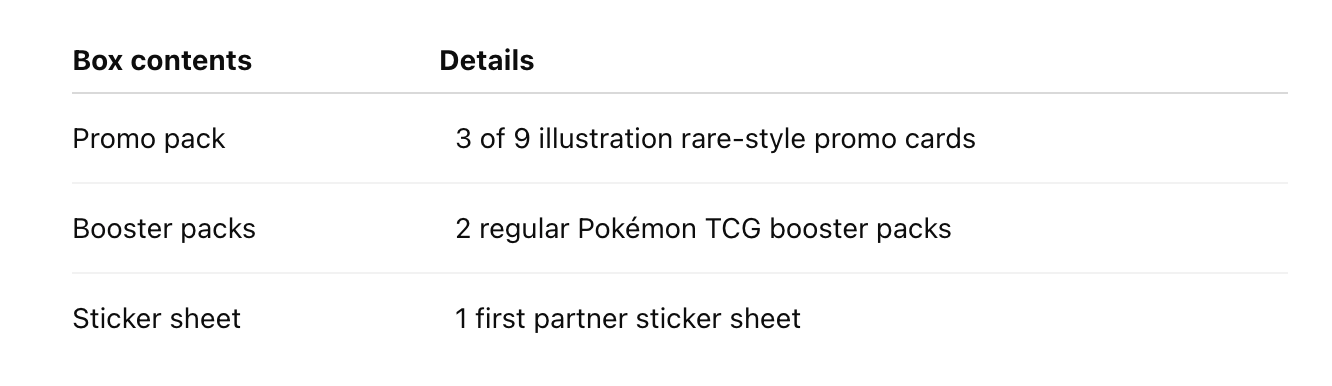
That is the basic product structure: one box, one regional trio, plus two regular booster packs and a sticker sheet. From there, the real collector question is which regional trios are included in each series — because the demand is not evenly distributed across all starters.
Here is how the English release breaks down by series.
Series 1
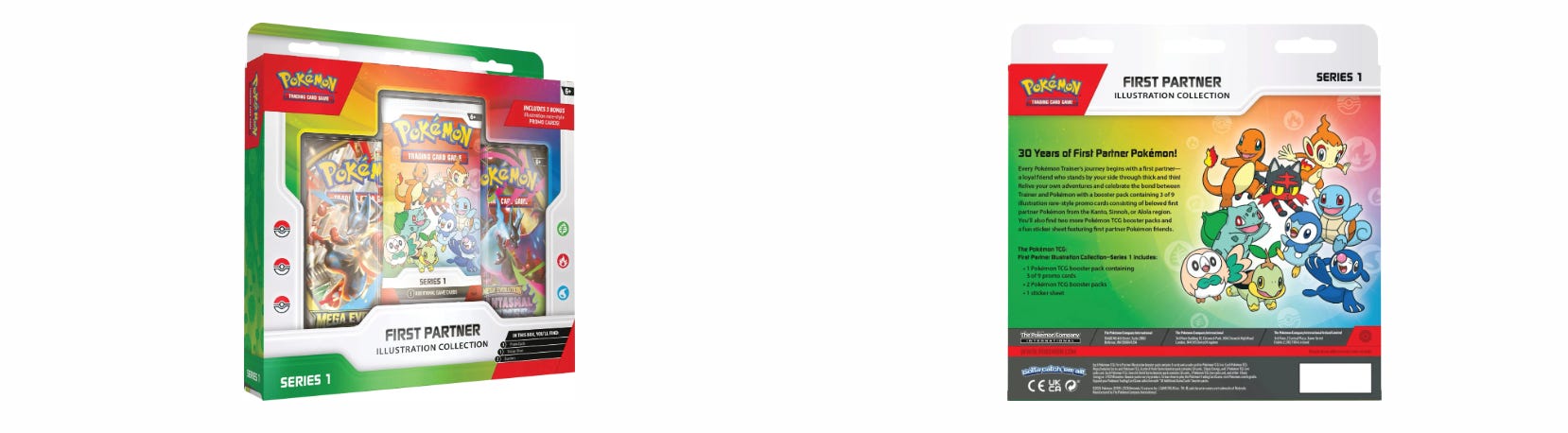
Series 1 contains the following promo cards: Bulbasaur, Charmander, Squirtle, Turtwig, Chimchar, Piplup, Rowlet, Litten, and Popplio.
The basic math is: 3 regions × 3 cards = 9 cards total
Charmander, Bulbasaur, and Squirtle are carrying most of the raw-card demand for Series 1. The non-Kanto cards still matter for set completion, but they do not have the same demand profile.
Series 2
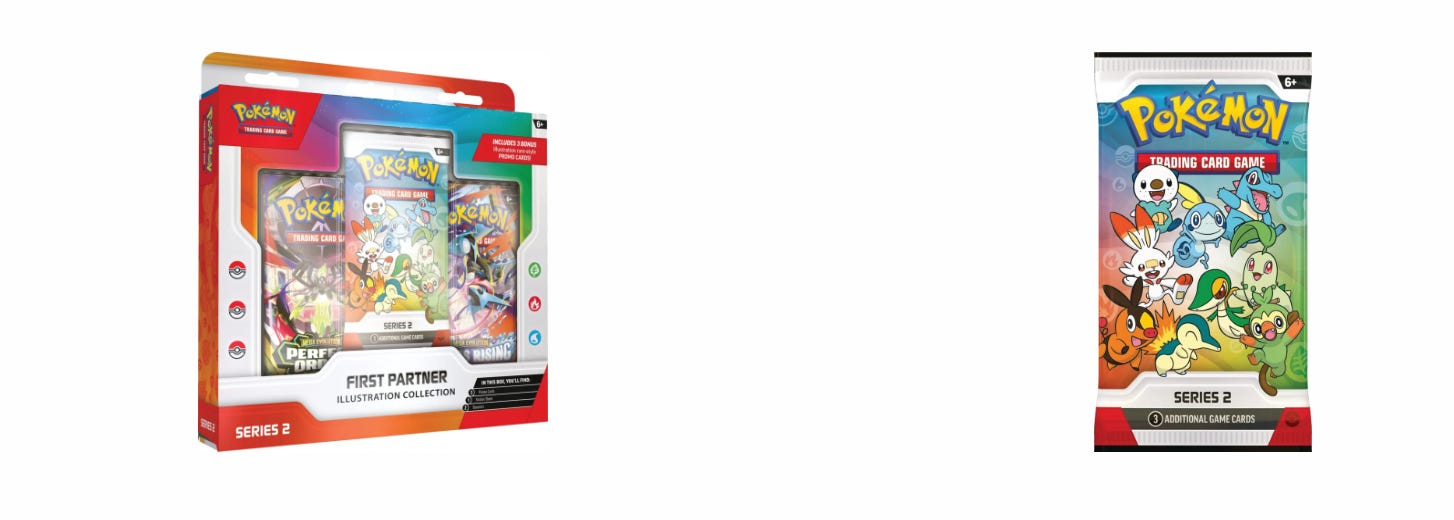
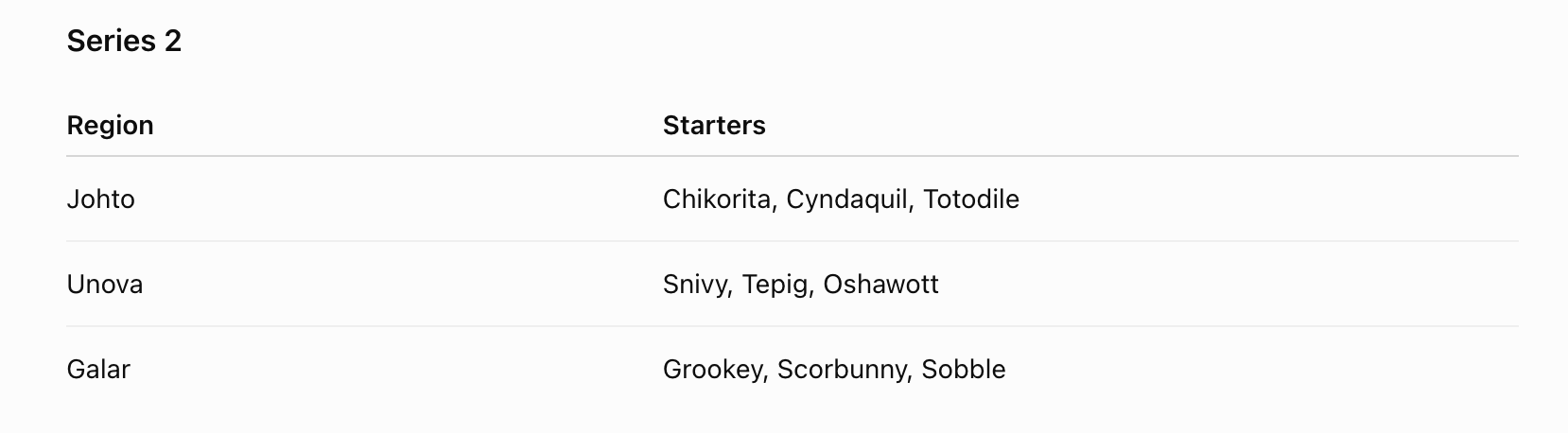
Series 2 was just released and includes the Johto, Unova, and Galar starters. The promo cards are as follows: Chikorita, Cyndaquil, Totodile, Snivy, Tepig, Oshawott, Grookey, Scorbunny, & Sobble.
Series 2 has not been on the market as long as Series 1, but the early pricing is already showing a familiar pattern. I bought a couple of boxes for around $50 on the secondary market. You can’t find any selling for the MSRP.
Series 3
Series 3 contains the remaining three starter regions:
Hoenn
Kalos
Paldea
PokéBeach first reported those regions in May, then later reported that all 27 starter promos had been revealed, including the previously unseen Hoenn, Kalos, and Paldea cards. Series 3 is important because it completes the 27-card English set.
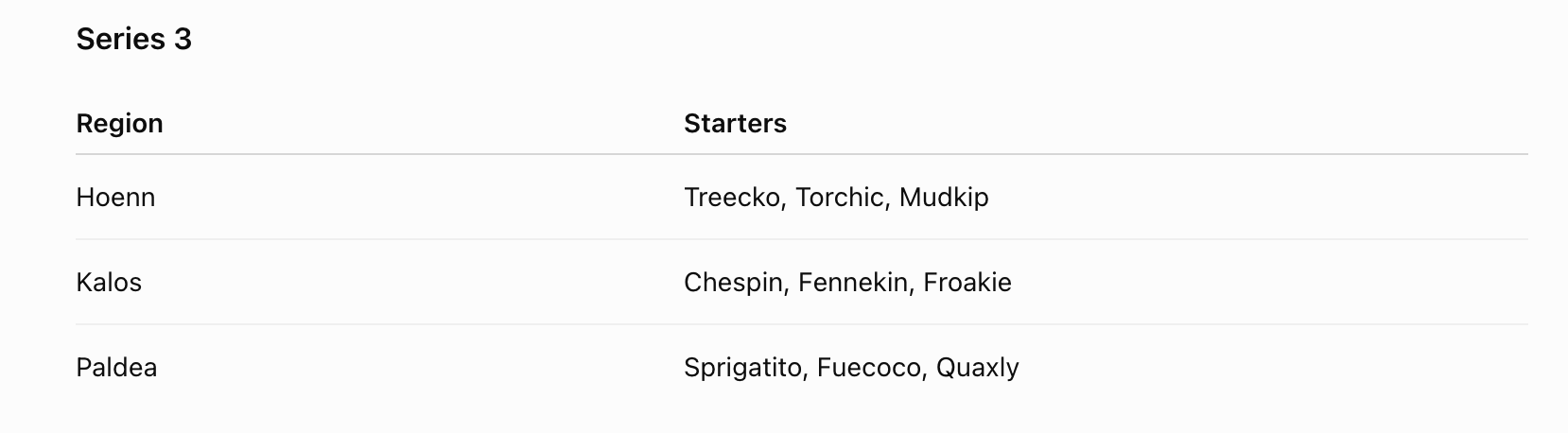
Hoenn will probably be the most in demand trio. Treecko, Torchic, and Mudkip have a stronger nostalgia profile than most modern starter trios, and I would not assume Series 3 will be weak just because it is the final wave.
Release schedule
Pokémon is releasing these promos in stages rather than all at once.
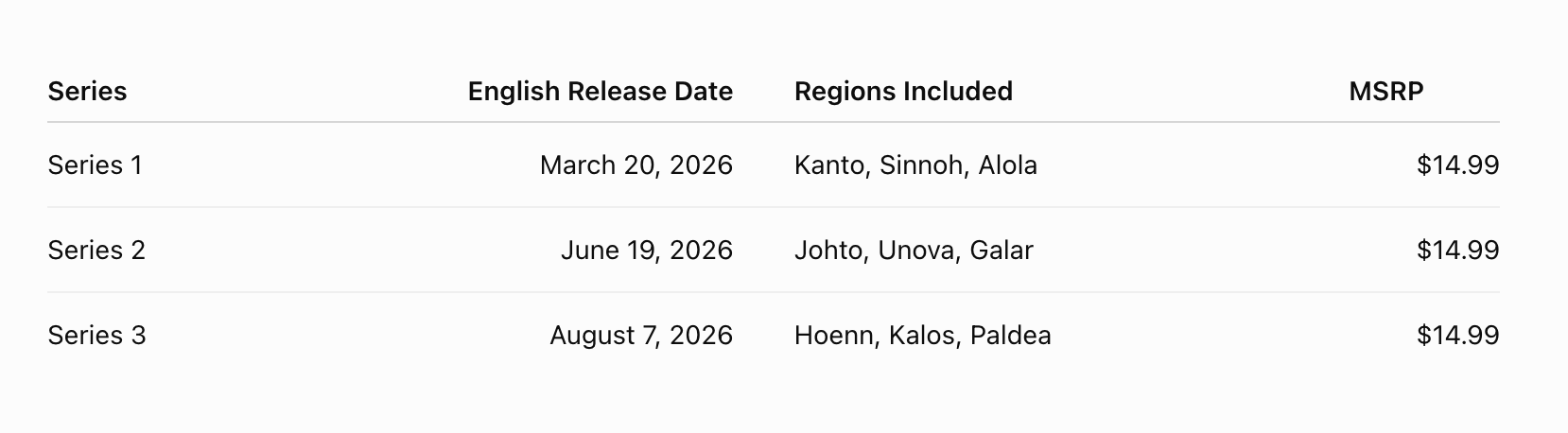
The English release schedule is as follows. By the end of the rollout, collectors will have a full 27-card First Partner Illustration Collection to chase.
The First Partner Illustration Collection is not English-only. Japan has its own version called the 30th Celebration Card Sets, scheduled for October 16, 2026, at 1,200 yen per box. The Japanese product is structured differently: each box contains three starter promos from the same generation, two 30th Celebration booster packs, and a paper display stand.
There is also a Simplified Chinese version in the market, which should be treated separately from English and Japanese for pricing. Do not blend comps across languages unless you are explicitly analyzing language arbitrage. English, Japanese, and Simplified Chinese may all have collector demand, but they are different markets with different supply, distribution, pricing, and buyer behavior. This article is strictly focused on the English promos.
What are the boxes selling for?
As of late June 2026, Series 1 is no longer trading like a normal $14.99 retail product. Secondary-market pricing is roughly in the $65–$80 range, with TCGplayer showing a market price in the mid-$70s and recent sales around that same level.

Series 2 has now released. Early post-release pricing appears to be settling lower than the earlier preorder spike, with boxes generally trading around the mid-$50s to mid-$60s. That is still roughly 4x retail, which tells you the demand is real even after the product has started hitting stores.
Series 3 has not released yet, so any pricing before real distribution is mostly speculative.
The important point is that buyers are not valuing these like ordinary $14.99 collection boxes. They are valuing them like premium promo collectibles with real secondary-market demand.
Series 1 & 2 raw card pricing snapshot
Series 1 has the cleanest market data so far because it has been live the longest. Series 2 is newer, but it is already showing a similar pattern: the most popular starter trio in each wave is carrying the raw-card market. Approximate raw prices as of late June 2026:
Series 1 Raw Prices
Below are the nine Series 1 First Partner Illustration Collection promos. The cards are grouped by region: Kanto on the top row, Sinnoh in the middle row, and Alola on the bottom row.
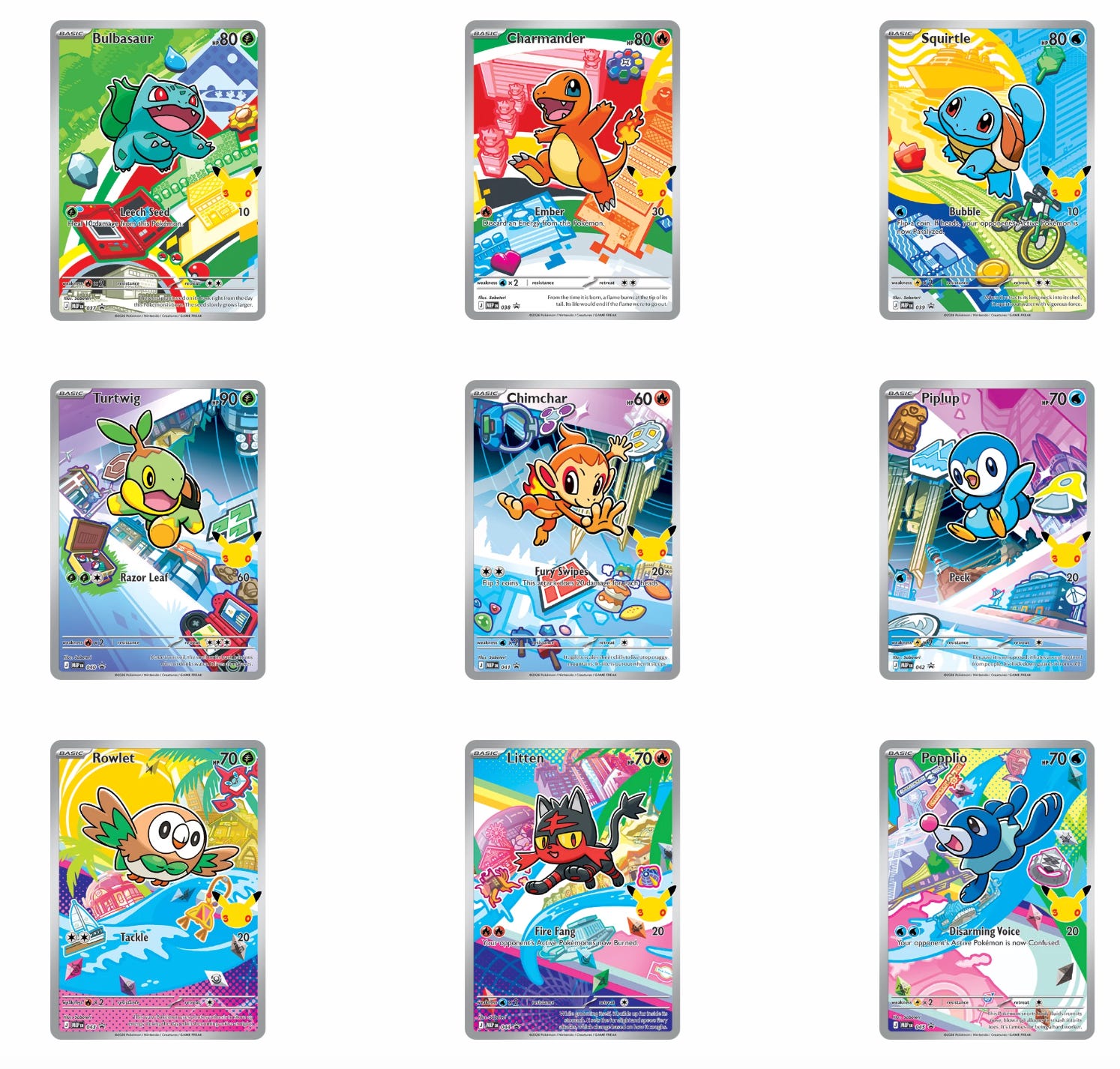
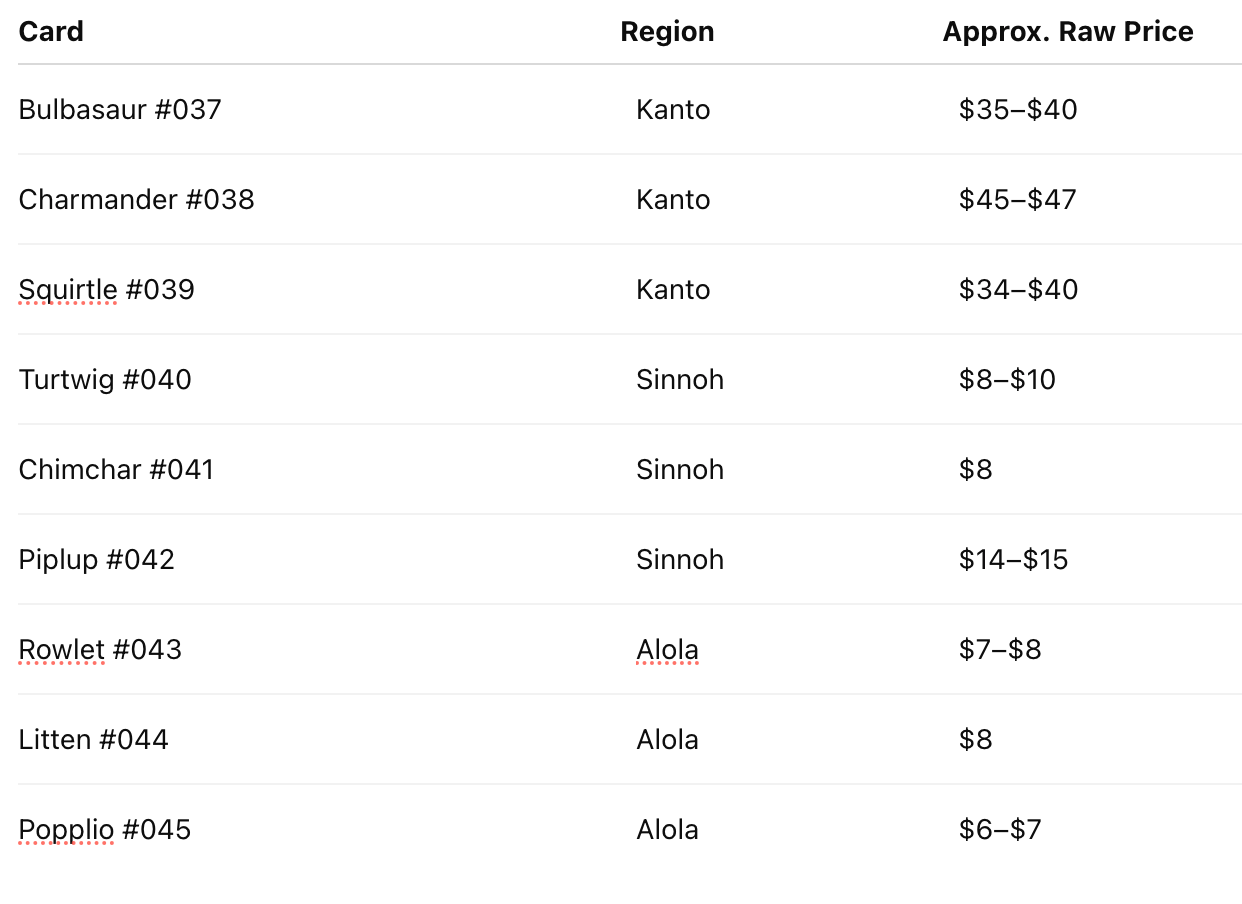
Here is the approximate raw price for each card as of June 26, 2026. The raw market is doing exactly what you would expect. Kanto is the most in demand. Charmander, Bulbasaur, and Squirtle are carrying the set. The non-Kanto starters are much cheaper raw, even when the artwork is strong.
Series 2
Below are the nine Series 2 First Partner Illustration Collection promos. The cards are grouped by region: Johto on the top row, Unova in the middle row, and Galar on the bottom row.
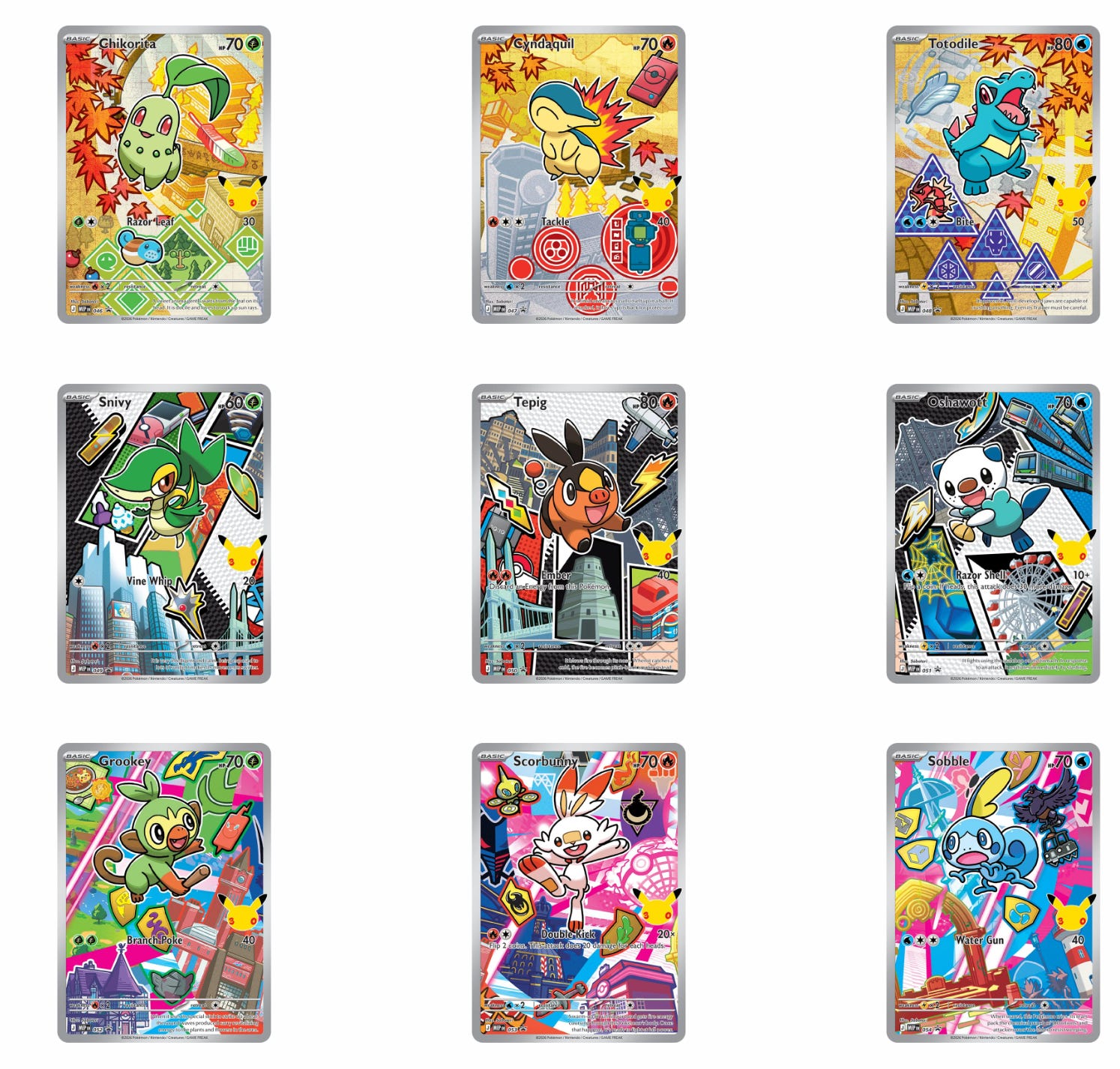
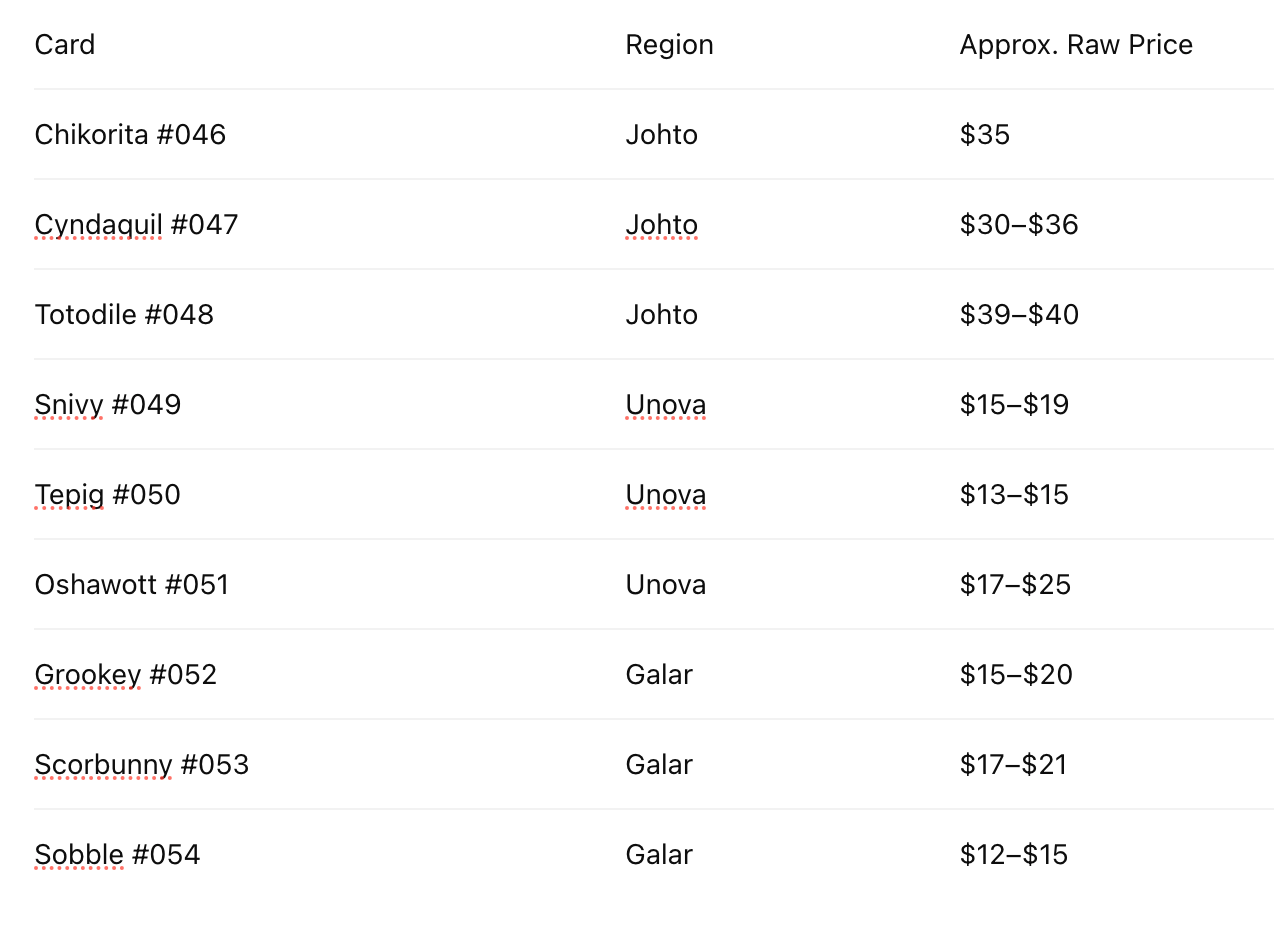
Here is the approximate raw price for each card as of June 26th, 2026. Series 2 has not been on the market as long as Series 1, but the early pricing is already showing a familiar pattern. The Johto starters are carrying the wave, with Totodile, Chikorita, and Cyndaquil leading raw demand. The Unova and Galar cards are still moving, but at much lower prices.
Based on current individual raw prices, a full raw Series 1 set is roughly a $165–$180 card set. That is already far above the clean MSRP math of three $14.99 boxes, but it lines up reasonably well with the current sealed-box market. If Series 1 boxes are selling around $65–$80 each, then three sealed boxes are roughly $195–$240 before tax and shipping. At that point, paying around $165–$180 for the complete raw set is not irrational. You are paying less than the implied cost of buying sealed boxes on the secondary market, and you are removing the risk of not ending up with the exact cards you need.
Series 2 looks similar, but with slightly different math. Based on current individual prices, the full raw Series 2 set is roughly a $190–$225 card set. Series 2 boxes are currently trading closer to $55–$65 each, which puts three boxes at about $165–$195 on the secondary market. That makes the raw set pricing a little more aggressive than Series 1, but not crazy given how new the release is and how strong the Johto demand appears to be.
The bigger point is that the raw sets are not trading off MSRP anymore. They are trading off secondary-market replacement cost. Once the boxes move from $14.99 retail products to $50, $60, or $70 secondary-market products, the raw cards have a new pricing floor. Collectors are no longer comparing a complete raw set to MSRP. They are comparing it to the cost, hassle, and availability of acquiring enough sealed product to complete the set.
Bottom line
The First Partner Illustration Collection promos are real collector-interest products, not random throwaway promos. The combination of starter Pokémon, anniversary timing, illustration-style art, blind regional packs, and set-building demand gives them a credible market setup.
At MSRP, the boxes were obvious buys. But MSRP is mostly theoretical now. The product sold quickly, many stores limited purchases, and the secondary market has already moved. That does not mean every box, raw card, or PSA 10 is automatically attractive. It means the product deserves serious attention.
The next question is not just what these promos are. The better question is how to approach them: sealed, raw, graded, or as a complete PSA 10 set. That is where the investment math starts.
In Part 2, for paid subscribers, I break down how I’m thinking about the actual investment setup: sealed boxes versus raw singles, raw-to-PSA 10 grading economics, population-growth risk, and why my preferred strategy is building toward a complete PSA 10 set.