

Disclaimer: This post is for entertainment only and is not financial advice. See full legal disclaimers here.
In a recent weekly update, I mentioned an article reporting that McDonald’s had teased another Pikachu collaboration promo coming in 2026. This article also referenced a similar promotion that ran in 2025. Not knowing much about how past McDonald’s collaborations perform in the market, I decided to dig into the 2025 release. I found a much crazier story than I expected, even by Pokémon standards.
The Original Promotion
In August 2025, McDonald’s Japan announced a Pokémon themed “Happy Set” promotion set to begin on August 8. Each “Happy Set” included one of nine Pokémon toys and for three days (August 9, 10, and 11) customers would also receive a two-card Pokémon pack with each qualifying purchase.
Each pack contained one guaranteed Pikachu promo & one randomly selected card featuring Sprigatito, Fuecoco, Quaxly, Ralts or Riolu

The featured Pikachu card, numbered 020/M-P and illustrated by Yuu Nishida, shows Pikachu with a tray of food and a McDonald’s logo stamped on the right side of the card (see image above). The most important detail was that Pikachu was not randomly inserted. Every promotional pack contained one.
McDonald’s asked customers to purchase no more than five “Happy Sets” during the card distribution period. The moment they had to say that, you knew things weren’t going to end well. The company also discouraged purchases made for resale and asked customers not to order more food than they could eat. Needless to say, those precautions weren’t enough. The promotion was immediately overwhelmed.
Collectors and resellers lined up outside restaurants, and participating locations quickly exhausted their supply. Japanese media reported the promotional cards had effectively sold out on the first day. Photos circulated of uneaten food discarded near McDonald’s locations, apparently left by customers who were primarily interested in the cards. McDonald’s later apologized and said it would consider stronger restrictions for future promotions. The toy promotion continued, but the card giveaway ended as soon as it began.
The Card Initially Appeared Scarce
During the launch, the card genuinely appeared scarce. Scheduled for only three days, the promotion was limited to Japan and the stores ran out almost immediately. International collectors had to purchase the card through Japanese resellers, making people believe it was difficult to obtain. All of these factors combined to create the appearance of scarcity.
But several details hinted that the eventual supply could be overwhelmingly large:
The cards were distributed nationwide in Japan
Every pack contained a guaranteed copy of the Pikachu
Customers could purchase up to 5 Happy Sets each
The card was inexpensive enough to acquire in quantity
The chaotic release restricted access to the card. It was initially difficult to obtain because demand overwhelmed the promotion, not because a small number of copies existed.
Cards Flooded into PSA
After the promotion had ended, enormous quantities of the Pikachu promo were submitted for grading. Professional grading takes time. This process creates a lag between a card’s release and when meaningful numbers of PSA 10 copies begin reaching the secondary market. That means initial PSA 10 copies and prices can dramatically overstate both the end-state value and rarity of a card. This McDonald’s promo is one of the most extreme examples of this I’ve seen.

By the beginning of 2026, roughly six months after the promotion began, PSA reported it had graded over 220,000 copies of the card. That makes it the most graded Pokémon card of the 2020s, more than twice as many PSA submissions as the Pikachu with Grey Felt Hat promo which ranks second at roughly 115,000 graded copies.
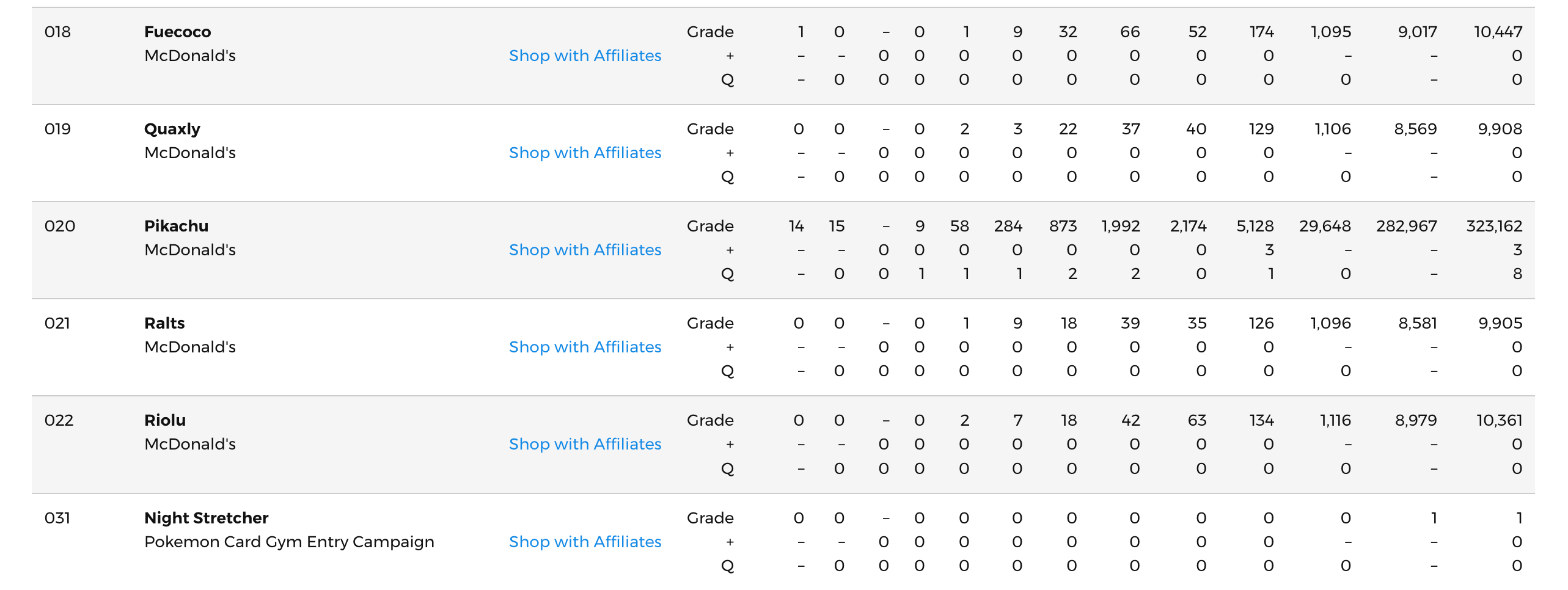
And the population has continued to climb. The latest pop report shows 323,162 total submissions, with an astonishing 282,967 copies receiving a GEM MINT 10. Those numbers don’t include raw copies and cards graded by CGC or Beckett. I can’t remember ever seeing a modern Pokémon card with a graded population that large. To put it in perspective examining two popular modern cards, the Umbreon VMAX from Evolving skies and the Charizard EX from 151 from Scarlet & Violet, have 21,378 PSA 10s and 28,316 PSA 10s respectively. The McDonald’s Pikachu has nearly 10 times as many PSA 10s as either one of them.

What Happened To The Price
The rumor is that early card and sealed packs commanded huge premiums ( into the thousands ) immediately after the promotion. It’s difficult to know exactly where everything traded because I don’t have visibility into all Japanese secondary market platforms or what local card shops were charging at the time. But here is what I was able to find.
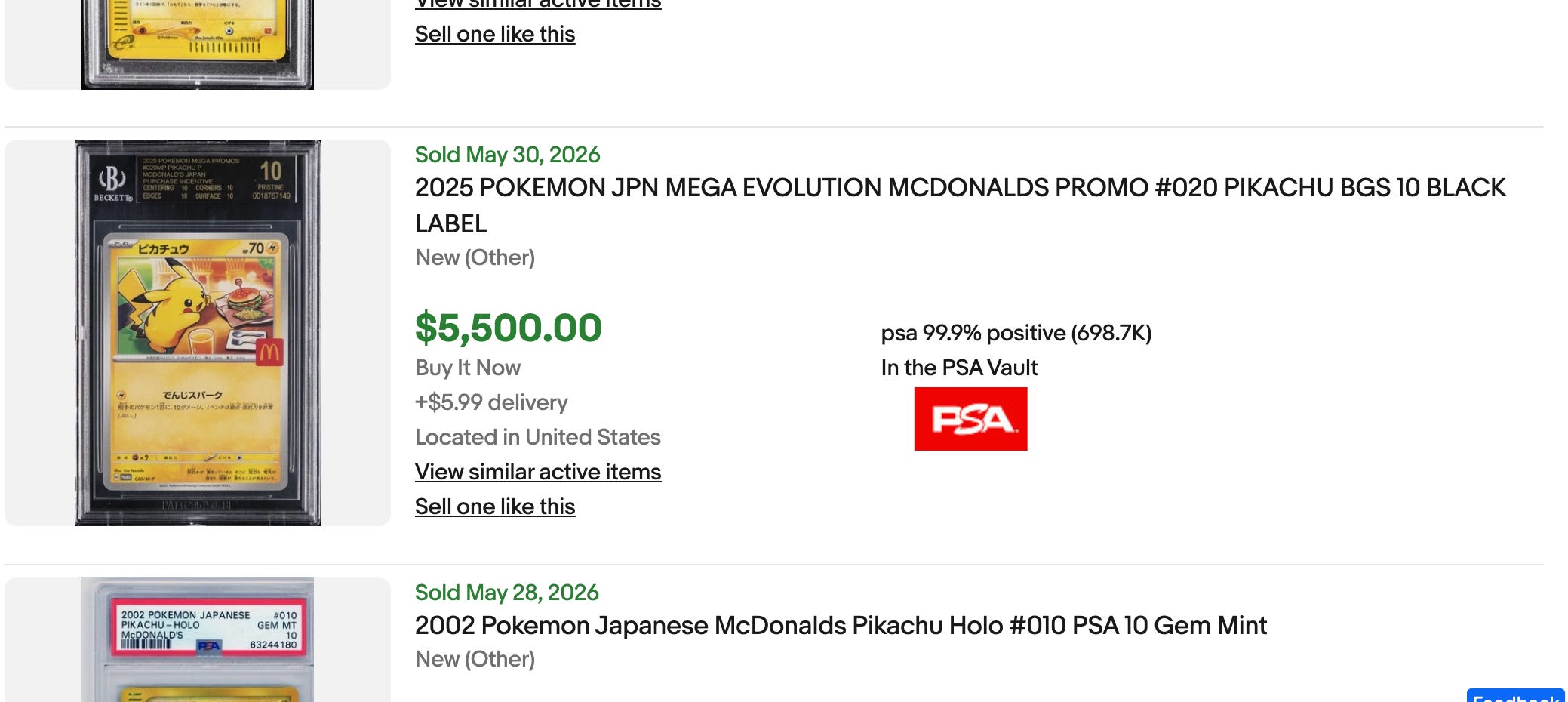
There were BGS Black Label copies clearing the market for more than $5,000, which is pretty crazy for a card that would eventually have more than 250,000 PSA 10s. Those sales appear to have been fairly rare. Looking at the broader historical price data, PSA 10 copies seem to have topped out around $300.
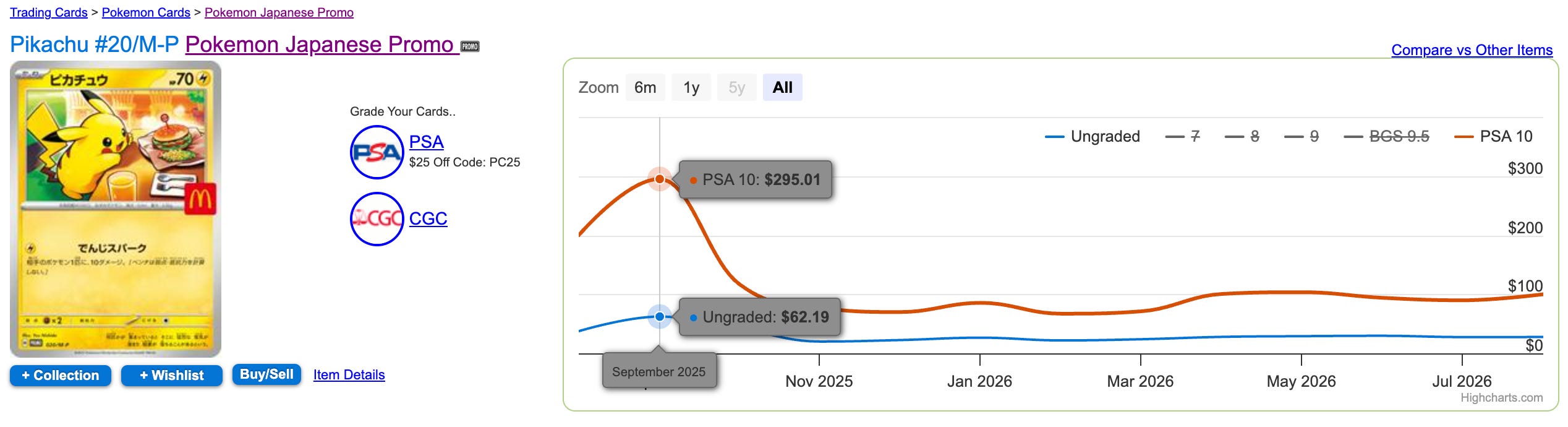
As more cards moved through grading, the population exploded causing prices to fall substantially. You can see from the graph above, by July 2026 recent PSA 10 sales where landing around $80-$100, while PSA 9 sales were around $40-$50. Whats interesting is that even with nearly 283,000 PSA 10 copies, it continues to sell for close to $100. That reflects the strength of demand for Pikachu promotional cards, the appeal of the artwork, and the memorable story surrounding the event.
What You Can Learn From It
Just because a promotional card sells out, it doesn’t mean it’s rare
The Pikachu promotion sold out because the demand exceeded the inventory available at individual McDonald’s locations. That tells us something important: the card had extremely strong demand. I always try to verify sufficient demand before I invest in a card. What it doesn’t tell us is how many cards were ultimately printed. A card can sell out and still have hundreds of thousands or even millions of copies in circulation.
Guaranteed cards can produce enormous populations
With modern Pokemon sets, the rarest chase cards can be extraordinarily difficult to pull. It’s not uncommon for Special Illustration Rares (or similar rare cards) to have pull rates approaching 1 in 1,000 packs or worse. For example, estimates for the Tree Pikachu from Ascended Heroes put the pull rate at roughly 1 in 1,533 packs. That puts a cap on how many copies can enter the marketplace. Even if millions of packs are opened, only a small percentage will contain the chase card. The McDonalds Pikachu has the opposite distribution model.
The Gem Rate Matters
The number of raw copies is only part of the supply equation. For many modern cards, a significant portion of the premium collector market is concentrated in Gem Mint copies. That means the percentage of cards capable of receiving a PSA 10 can have a major effect on the supply that matters most at the high end of the market. If a card has centering problems, print defects, edge wear, poor cutting, or other manufacturing issues (which can be common), a low gem rate can create an additional layer of scarcity even when the raw card itself is relatively common. The McDonald’s Pikachu had no such problem.
Of the copies submitted to PSA, approximately 87.5% have received a GEM MINT 10. That is an extraordinarily high gem rate, and when you combine it with the massive number of raw copies entering the grading pipeline, the PSA 10 population explodes.
To drive the point home, here are the two supply variables that you really care about:
How many raw copies exist
What percentage of those copies can achieve a Gem Mint grade
A card with a huge raw population can still have relatively few PSA 10s if the gem rate is low. The McDonald’s Pikachu had both a huge raw supply and an extremely high gem rate. That is the worst possible combination if you are looking for price appreciation.
A high population count doesn’t automatically make the card worthless
You would think with a population count of PSA 10’s nearing 300,000, the card would basically be worthless. But its not. It still sells for almost $100. Since grading is currently at $80/card, I tried to win one for less than $80 in an auction (basically getting the card for free) but was unsuccessful. Most of the listings I bid on went for over $100. My guess is because it’s now attached to a memorable event. It’s promotion created lines, sellouts, resale controversy, pictures of wasted food, and the largest grading waves the hobby has even seen. That makes the card culturally interesting and collectible.
Final Thoughts
Do I think this card is a good investment for price appreciation ? Probably not.
Will I end up adding it to my personal collection? Unfortunately, yes.
There is most likely a cap on how much appreciation this card can experience, just from the sheer number of graded copies. And there is no rush to get one. With a population of that size, there will always be copies available on the secondary markets.. But if you are in it for the love of the game like me, you’ll end up buying a copy simply because it’s a Japanese Pikachu promo with an interesting story behind it. I suspect many collectors will feel the same.
Take notice those there are two different decisions. As a Pokemon enthusiast, I’ll happily pay $100 that was part of a cultural event. Thats was a personal collection is for. But the ZeroToHero portfolio exists to make money. A card with 283,000 PSA 10s and a fully diluted supply already priced in doesn’t get a spot. If it does surprise to the upside, I’ll take that into account when deciding how to invest in similar collaborations in the future.
If there is one lesson I want to emphasize from this situation it’s this: Don’t rush to buy a raw or graded PSA 10 of a popular card until you have some visibility into the number of copies and gem mint rate. Those two numbers make it possible to calculate some basic replacement costs. That replacement cost helps you put an economic floor under the price.