

Disclaimer: This post is for entertainment only and is not financial advice. See full legal disclaimers here.
Before I buy any Pokémon card — raw or already graded — I run math. The goal is not to predict the future perfectly. The goal is to avoid guessing.
For any serious card, I want to compare the main acquisition paths:
Open packs
Buy raw
Buy raw and grade
Buy the PSA 10 directly
Most collectors look at the raw price and the PSA 10 price and assume the spread is profit. That is usually wrong. The spread only matters after you account for pull rates, grading odds, grading fees, failed grades, shipping, taxes, selling fees, time, and liquidity.
The basic questions are:
What are the pull rates?
What does it cost, on average, to pull the card from sealed product?
How does that compare to the current raw price?
What are the odds a raw copy actually becomes a PSA 10?
Is the PSA 10 premium large enough to justify buying raw and grading?
Or is it smarter to buy the PSA 10 outright?
That is acquisition math. It does not tell me which card is the chase card. That is a separate judgment. This framework helps me decide the right way to buy a card once I already know I want exposure.
1: Calculate Pack-Implied Replacement Cost
The first number I calculate is the card’s pack-implied replacement cost. That is the estimated cost to pull the card from sealed product instead of buying it as a single. This matters because every new raw copy has to come from opened packs. If a card takes hundreds or thousands of packs to pull, new supply is expensive to create.
That does not mean every hard-to-pull card is a good buy. Pull difficulty only matters if there is real demand behind it. Character, artwork, set context, liquidity, and entry price still matter.
But for a true chase card, pack-implied replacement cost gives me an important reference point. It is not a hard floor. Singles can trade below pull cost, especially when release supply is flooding the market or reprints are still hitting. But if a card takes hundreds or thousands of packs to pull, then new supply is expensive to create. That gives the raw price economic support, as long as collector demand remains intact.
That is why I start here. Replacement cost tells me whether opening packs makes sense and whether the raw card has support underneath it. It does not tell me the full strategy. After that, I still need to compare the raw price, the PSA 10 price, the gem rate, grading fees, failed grades, and time.
In other words, replacement cost answers the first question: Is this card expensive to produce from sealed product?
The next question is: What is the smartest way to acquire it?
The easiest way to see why this matters is to run the numbers on a real card. Let’s walk through the calculation using Mega Charizard X ex from Phantasmal Flames.
Example: Mega Charizard X ex
The Mega Charizard X ex is the main chase card from Phantasmal Flames. If we want to acquire it as an investment piece, the first question is simple: what would it cost, on average, to pull one from sealed product?
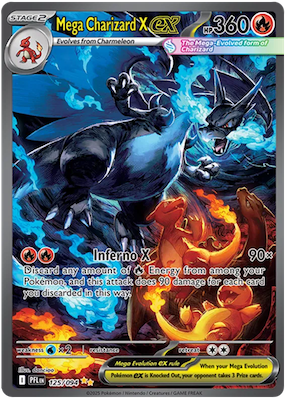
Series: Mega Evolution Series
Set: Phantasmal Flames
Card: Mega Charizard X ex (125/94)
Rarity: Special Illustration Rare
The first thing I do is look up the pull rates. For this example, I’m using TCGplayer’s published pull-rate estimate.

According to TCGplayer, the estimated pull rate for any Special Illustration Rare in Phantasmal Flames is about 1 in 80 packs. If a standard Pokémon booster pack costs $4.50, then the expected cost to pull any Special Illustration Rare is:
Special Illustration Rare Cost = $4.50 per pack × 80 packs = $360
Next, I pulled the current market price for all the Special Illustration Rares from Phantasmal Flames (see below)
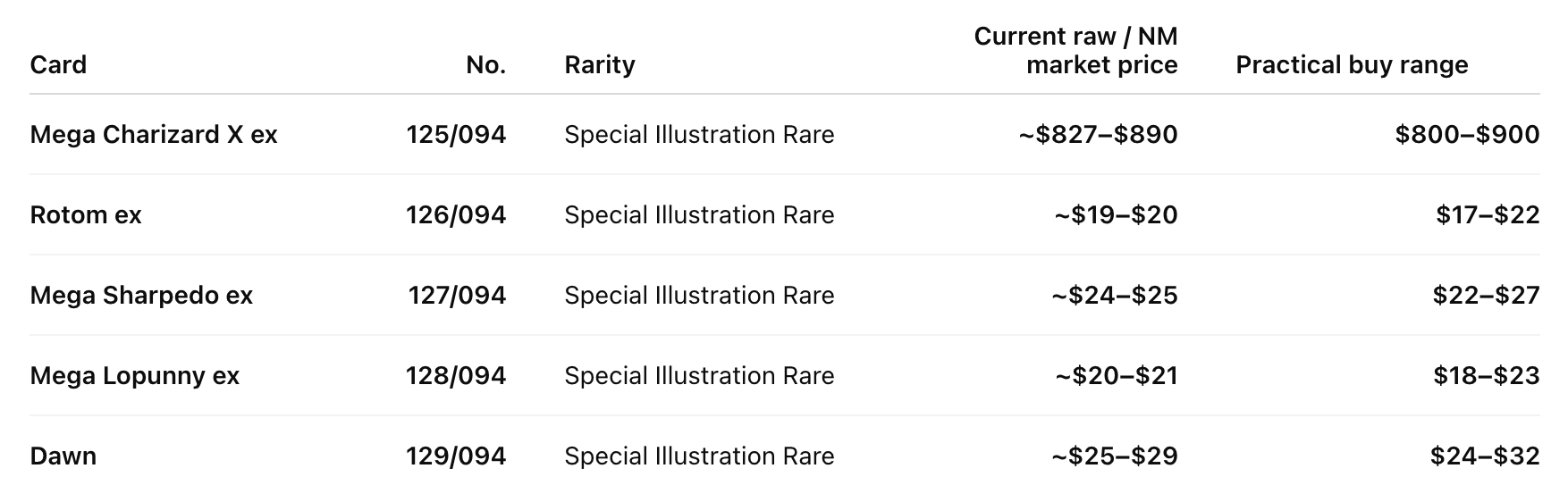
You can see in the table 4 of the 5 SIR’s can be purchased raw for about $25.
That immediately rules out opening packs as the acquisition strategy for most SIRs. Most of the Special Illustration Rares from Phantasmal Flames can be purchased raw for around $25. Opening packs to acquire those cards makes no financial sense. You would be spending hundreds of dollars, on average, to pull a card you could buy for a fraction of that price. Opening packs may be fun. It is usually not a serious acquisition strategy.
But chase cards are different. In this set, the card most buyers care about from an investment perspective is Mega Charizard X ex. The current raw market price is much higher than the other SIRs — roughly $800–$900.
So the real question is not:
» What does it cost to pull any SIR?
The real question is:
» What does it cost, on average, to pull this specific SIR?
If the set has roughly five Special Illustration Rares and we assume they are distributed evenly, then pulling Mega Charizard X ex specifically would require about five SIR pulls on average.
The math becomes:
Mega Charizard X Cost = $4.50 per pack × 80 packs per SIR × 5 SIRs = $1,800
So the pack-implied replacement cost of one raw Mega Charizard X ex is about $1,800. That does not mean the card has to trade at $1,800 raw. The singles market can price cards below pull cost, especially right after release when supply is hitting the market quickly. But it means a new raw copy is expensive to create. That is the key distinction between a random $25 SIR and the main chase card from the set. Both may have the same rarity label. They do not have the same demand profile, liquidity, or acquisition math.
Now the next question is grading.
If I can buy the raw card for far less than its pack-implied replacement cost, should I buy raw and submit it to PSA? Or should I skip the uncertainty and buy the PSA 10 directly?
2: Adjust For Grading
The raw card is only part of the decision. Recent PSA 10 sales for Mega Charizard X ex have been around $2,300.
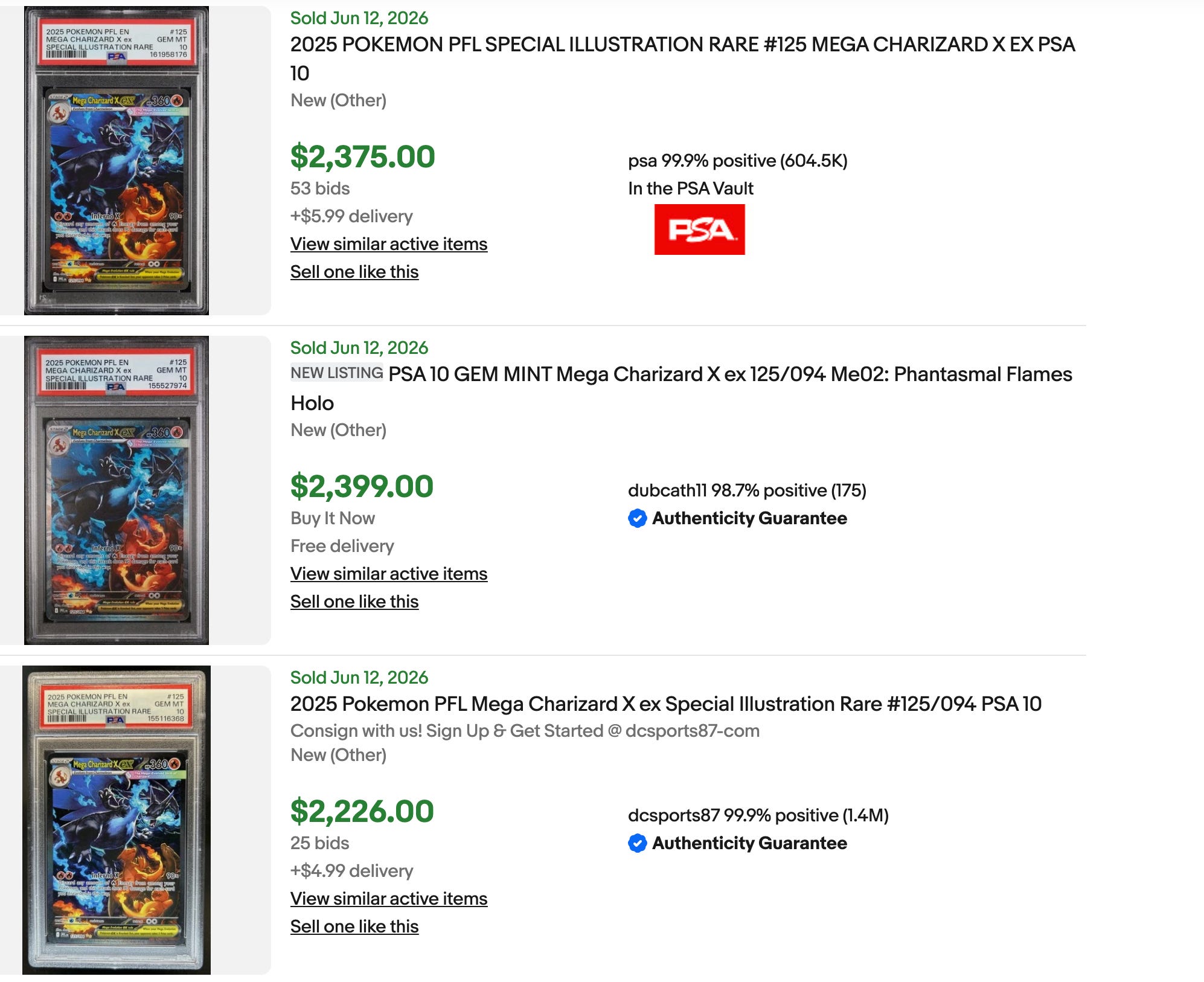
At first glance, the opportunity looks obvious:
buy raw for around $900
submit to PSA
pay the grading fee
end up with a PSA 10 worth around $2,300
But a raw card is not automatically a PSA 10. Before I assume a raw copy can become a 10, I want to know how difficult the card is to grade. That means checking the PSA population report.
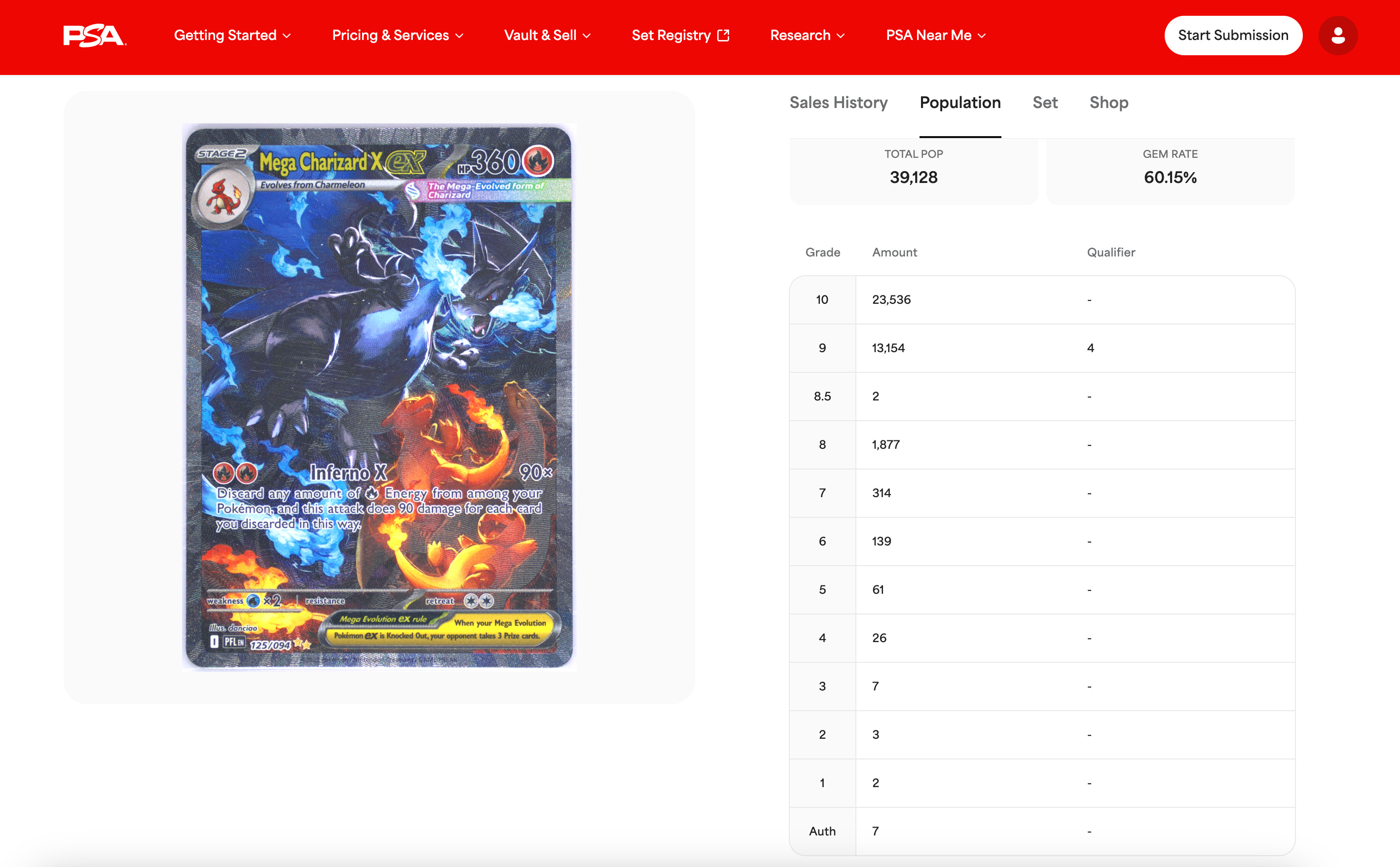
For this card, PSA shows 23,536 PSA 10s out of 39,128 total graded copies. That is a PSA 10 gem rate of about 60%. But that number needs to be interpreted correctly. A 60% gem rate does not mean 60% of all copies in the wild are PSA 10 quality. People usually do not submit obviously damaged, off-center, whitened, or scratched copies. Most submitters pre-screen before paying grading fees, shipping, and insurance.
So I read the PSA gem rate like this:
» Of the copies people thought were worth grading, 60% received a PSA 10.
That is useful, but it should not make you casual. Even after pre-screening, 40% of submitted copies did not get a 10. If the PSA 10 rate is 60%, then the expected number of raw copies needed to produce one PSA 10 is: 1 ÷ 0.60 = 1.66 copies. Now we can update the math.
First, the pack-implied replacement cost for one raw copy:
» Raw Replacement Cost = $4.50 per pack × 80 packs × 5 SIRs = $1,800
Then the pack-implied cost to produce one PSA 10:
» PSA 10 Replacement Cost = $4.50 per pack × 80 packs × 5 SIRs × 1.66 copies = $2,988
So while the raw card may trade around $900 and the PSA 10 may trade around $2,300, the estimated cost to produce a PSA 10 from sealed product is almost $3,000. That is why paying $2,300 for an already graded PSA 10 can still make sense.
You are not just paying for the card. You are paying to remove uncertainty:
no need to open hundreds of packs
no need to find a clean raw copy
no need to submit and hope PSA gives it a 10
no need to recycle failed grades
A PSA 10 can look expensive compared to a raw copy. But if the PSA 10 trades below the economic cost of producing another PSA 10 through packs and grading, the price may have more support than it appears. That does not automatically mean buy the PSA 10. It means the PSA 10 price is not random. There is acquisition math underneath it.
3. Buy Raw And Grade vs Buy The PSA 10
Now that we have estimated the replacement cost, the next question is acquisition strategy. Should I buy raw copies and try to grade them myself? Or should I skip the uncertainty and buy the PSA 10 directly? This is where a lot of investors make bad decisions. They look at the raw price and the PSA 10 price and assume the spread is profit.
Using the example:
Raw copy: $900
PSA 10 copy: $2,300
Apparent spread: $1,400
That spread is not pure profit.
The real question is: What does it cost me, on average, to produce one PSA 10?
With a 60% PSA 10 rate, I need about 1.66 raw copies to produce one PSA 10. So the expected raw-card cost per PSA 10 is: $900 × 1.66 = $1,494. Now add grading. For simplicity, assume a $20 grading fee per card. In a real purchase, I would use the actual grading tier, shipping, insurance, taxes, and any possible upcharges. But for a clean baseline: $20 × 1.66 = $33. So the rough baseline cost to produce one PSA 10 is: $1,494 + $33 = $1,527
That looks good compared to buying the PSA 10 directly for $2,300. But it is still not frictionless. I have to find clean raw copies, inspect photos, avoid hidden flaws, pay transaction costs, receive and inspect the card, submit it, wait for PSA, and deal with any failed grades. If a card comes back PSA 9, I do not reset the trade for free. I either keep the 9, sell it, or try again. Every option has a cost. That is why the raw-to-PSA 10 spread has to be wide enough to compensate me for more than just the grading fee. It has to compensate me for execution risk.
Why Gem Rate Changes the Decision
Now keep the prices exactly the same, but change only the PSA 10 rate.
Assume:
Raw copy: $900
PSA 10 copy: $2,300
Grading fee: $20
PSA 10 gem rate: 85% instead of 60%
At an 85% gem rate, I do not need 1.66 raw copies to produce one PSA 10. I need:
1 ÷ 0.85 = 1.18 copies
Now the math changes: $900 × 1.18 = $1,062 expected raw-card cost
Grading fees: $20 × 1.18 = $24
Baseline cost to produce one PSA 10: $1,062 + $24 = $1,086
Same raw price. Same PSA 10 price. Same grading fee. Completely different decision. At a 60% gem rate, buying raw and grading may still work, but I need to be much more careful. The margin can disappear quickly after shipping, insurance, failed grades, selling fees, and time. At an 85% gem rate, raw-and-grade becomes much more attractive. The expected cost to produce a PSA 10 is lower, and there is more room for friction before the trade stops making sense.
That does not mean I automatically buy raw at an 85% gem rate. I still need to inspect the specific copy. I still need to make sure the raw card is not overpriced. But the higher the gem rate, the more forgiving the raw-and-grade strategy becomes. The lower the gem rate, the more I prefer buying the PSA 10 directly unless the raw copy is unusually cheap or unusually clean.
The Two Routes Have Different Advantages
Buying raw and grading can produce a better return, but only if the spread is wide enough and your grading edge is real.
The raw-and-grade route requires:
finding raw copies that actually look gradable
inspecting photos carefully
avoiding sellers hiding flaws
paying taxes, shipping, and marketplace fees
inspecting the card again in person
paying grading fees, shipping, insurance, and supplies
waiting while the card is at PSA
accepting the risk that the card comes back a 9 or lower
Buying the PSA 10 is cleaner.
You pay more upfront, but you remove several uncertainties:
no grading risk
no condition risk
no submission delay
no failed-grade recycling problem
less execution burden
The mistake is thinking the PSA 10 is automatically too expensive because the raw card is cheaper. The raw card is cheaper because it carries uncertainty. The PSA 10 is more expensive because that uncertainty has already been resolved.
My Decision Rule
For me to buy raw and grade, I need a large enough spread to justify the work and risk.
The spread has to cover:
enough raw copies to realistically produce a 10
grading fees
shipping and insurance
failed grades
marketplace fees
time
the chance that the market moves against me while I wait
If the spread is wide, the gem rate is favorable, and I have a real edge finding clean copies, buying raw and grading can be the better strategy. If the spread is thin, the gem rate is low, or I do not have a strong edge finding clean raw copies, I would rather buy the PSA 10 directly. In the Mega Charizard X ex example, with a 60% PSA 10 rate, I would probably buy the PSA 10 unless I had a strong edge finding unusually clean raw copies or I can get a steal buying a raw copy in an auction.
If the same card had an 85% PSA 10 rate, the decision would change. Raw-and-grade becomes much more interesting because the expected number of raw copies needed to produce one PSA 10 drops from 1.66 copies to 1.18 copies. That difference matters.
Bottom Line
The spread between a raw Pokémon card and a PSA 10 is not automatically profit.
Raw is better when the spread is wide, the gem rate is high, and your grading edge is real.
PSA 10 is better when the spread is too thin to compensate you for uncertainty, time, failed grades, fees, and execution risk.
Opening packs is usually the worst acquisition strategy if your goal is to get a specific card. Buying raw or buying graded is usually cleaner.
But the pack math still matters. If a chase card takes hundreds or thousands of packs to pull, that creates real economic support under the price. It does not guarantee the card cannot fall, but it means new supply is expensive to create. For the right card, that changes how I think about downside risk.