

Disclaimer: This post is for entertainment only and is not financial advice. See full legal disclaimers here.

This set is the first expansion in the Mega Evolution series and was released on September 26th, 2025. It’s been almost a full year since its release. In the future I will write these about 6 months after a set becomes available, but this gives us plenty of data to work from. This set includes the English prints of cards primarily from the Japanese expansions Mega Brave and Mega Symphonia (reviews coming soon). Here is a quick snapshot of the set:
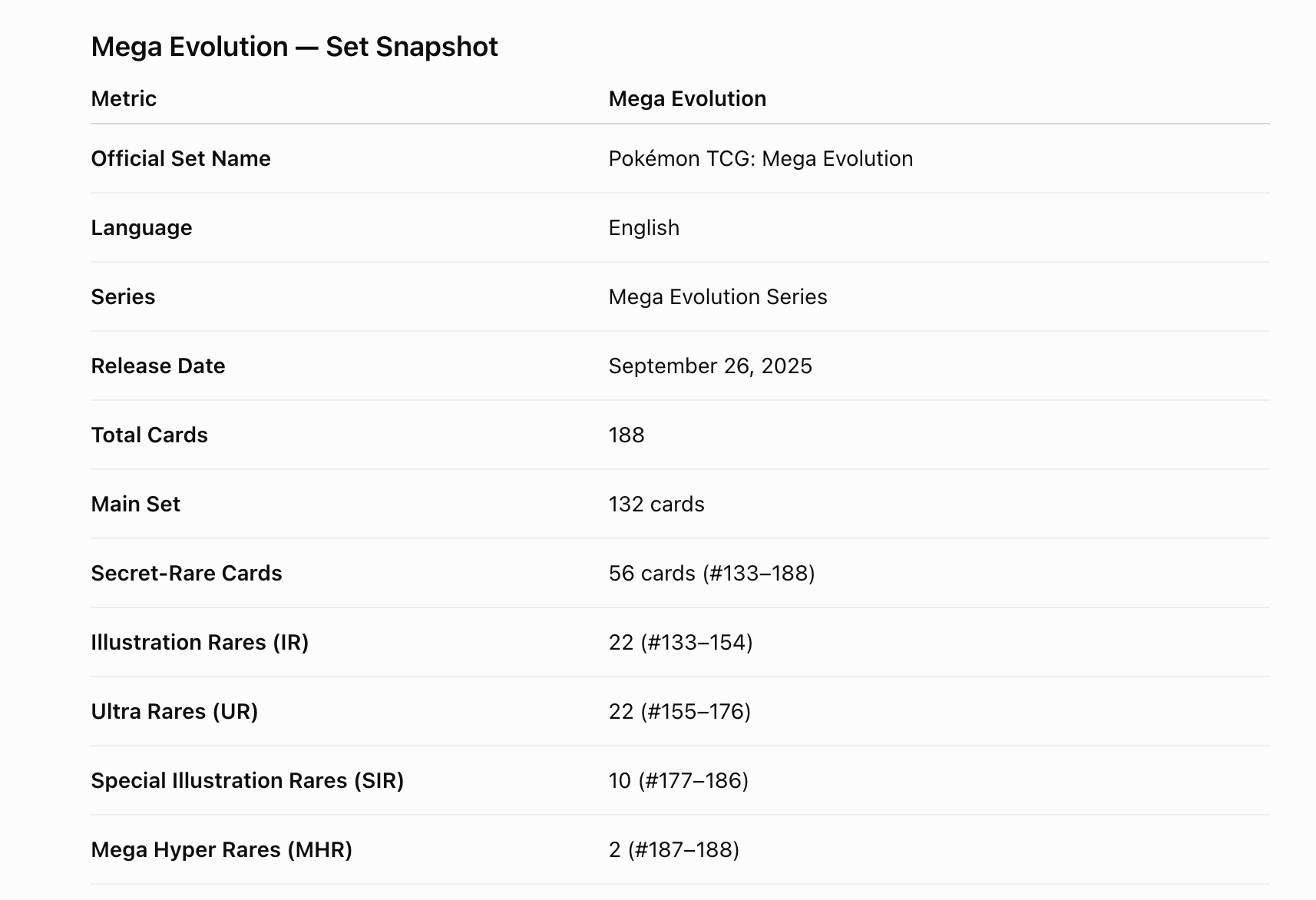
The set breaks down like this. The set is 188 cards, 132 in the numbered set and 56 Secret Rares. The Secret Rare breakdown is as follows
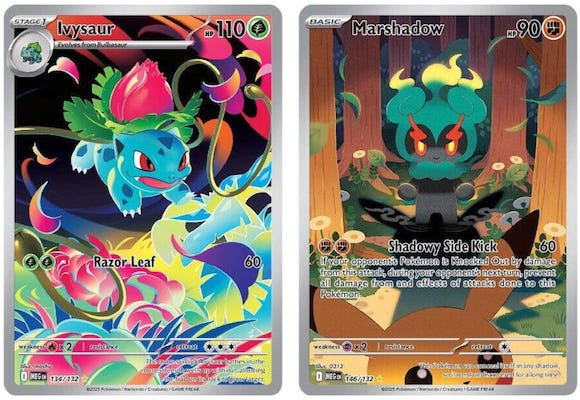
22 Illustration Rare
22 Ultra Rare
10 Special Illustration Rare
2 Mega Hyper Rare
Browse This Set: View All 188 Mega Evolution Cards Here
Introduction of Mega Hyper Rare

Pokémon introduced a new rarity type with the release of this expansion, the “Mega Hyper Rare”. Gold cards are not new. Sword & Shield featured gold “Secret Rares”, while Scarlet & Violet renamed the top gold rarity “Hyper Rare”. Despite sitting at the top of the rarity ladder, these cards generally didn’t attract the same collector demand as Sword & Shield alternate arts or Scarlet & Violet Special Illustration Rares. They were full-art cards with gold backgrounds and borders. Despite having pull rates in line with the Special Illustration Rare inserts, gold “Hyper Rares” were not the most desirable cards in those sets. Most of the collector demand was concentrated on the Special Illustration Rares or Alternative Arts. It’s counterintuitive because while they had the highest rarity, they were worth considerably less than the most desirable SIR inserts. I didn’t go heavy into buying these in the past because they simply didn’t perform as well on an ROI basis.
The new Mega Hyper Rare retain the all-gold concept of their predecessors, but differ in that they have a gold-etched holographic design and alternate artwork (where Hyper Rares were gold treatments of the Pokémon ex or Trainer cards so the artwork wasn’t unique). They also have their own rarity symbol. Mega Evolution has two of these MHRs - Mega Gardevoir ex and Mega Lucario ex. Pokémon appears to be repositioning these as “true” chase cards instead of a premium treatment of a card. These are extremely difficult to pull. For Mega Evolution, it’s 1 in 35 booster boxes. But it remains to be seen if these will perform better than the gold cards from previous eras.
Top Cards By Price
Below are the top 10 cards ranked by current market price. You can see from the table that the list is dominated by the Special Illustration Rares and the Mega Hyper Rares we just discussed. When cards first hit the market, there is a “release premium” for the top cards. We are nearly a year from that release, and that premium has largely dissipated from the market. Every single card in the top ten is below its release price, with 4 of them down over 60%. This is why I stress waiting for this premium to disappear. You cannot take an immediate 60% haircut in the price you paid and expect to make money. It ties your capital up far too long waiting for the price to recover, when your goal should be turning over cards for profit.
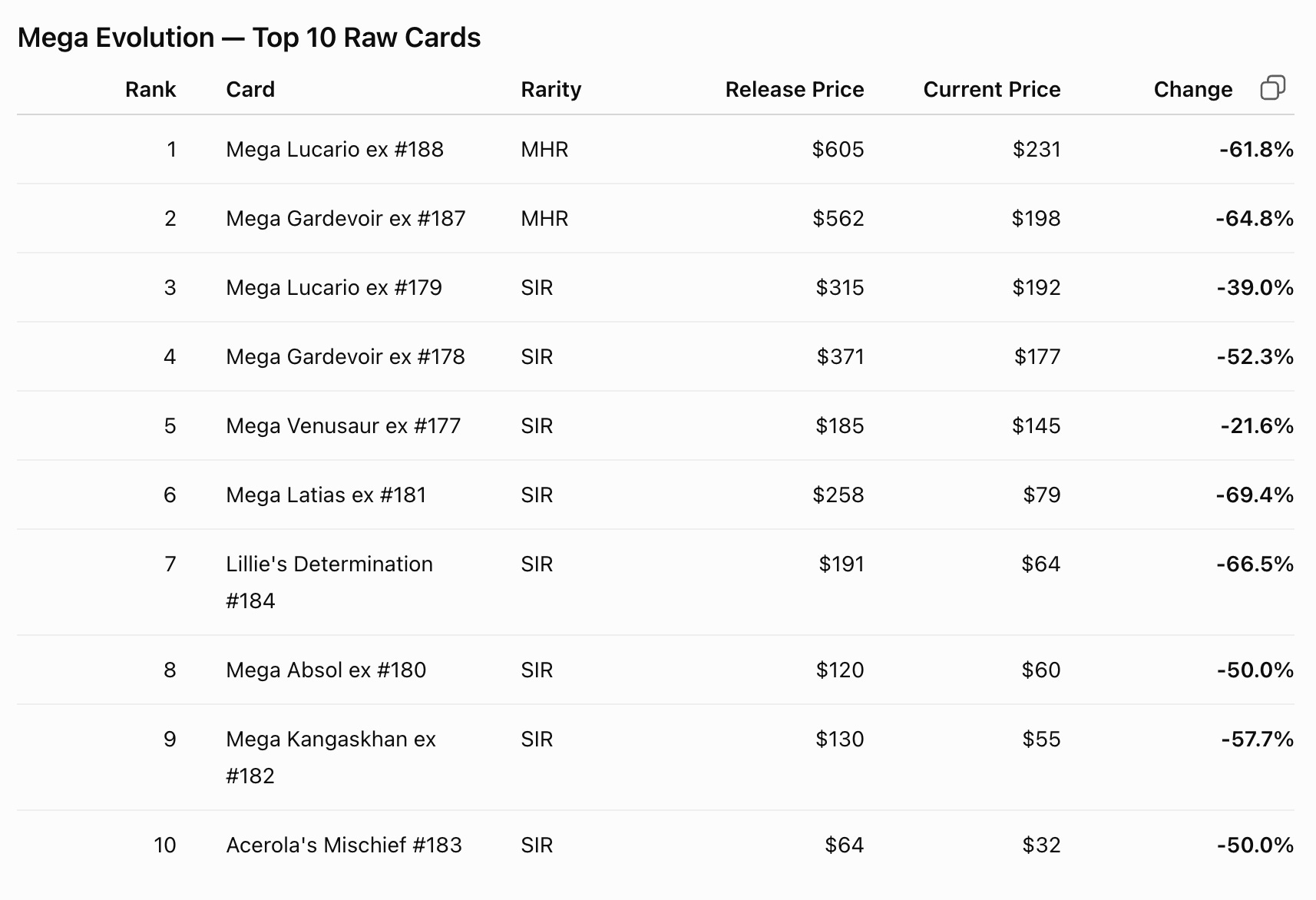
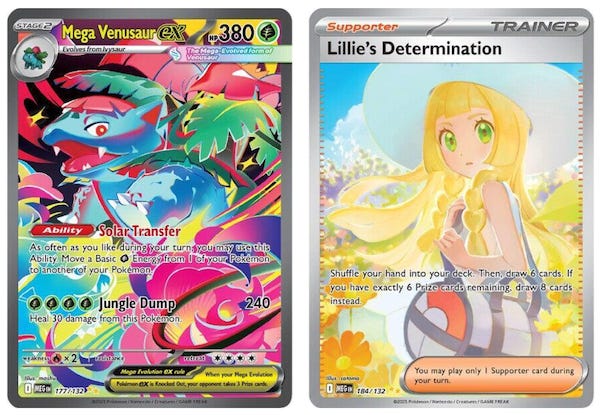
Mega Latias, the Mega Hyper Rares, and Lillie’s Determination took the sharpest hits. This isn’t a surprise to me. In my experience trainers often have some of the steepest post release drawdowns and as I discussed I’m still skeptical of the premium the gold rares are selling for. Mega Latias has declined the most which is a bit of a surprise since Latias has a real following and is featured in one of the most expensive and sought after cards from the Sun & Moon era.
Pull Rates
The Mega Evolution pull rates are in line with what we saw during the Scarlet & Violet era until we get to the very top. Illustration Rares and Ultra Rares are 1 in 9 and 1 in 12 packs respectively, while the Special Illustration Rares are 1 in 101 packs. That isn’t particularly high for modern Pokémon. The real outliers are the Mega Hyper Rares. TCGPlayer estimates pulling a copy once in every 1,260 packs. That means to pull a specific MHR, you’re looking at ripping 2,520 packs. That amounts to 35 booster boxes for any MHR and 70 booster boxes for a specific one (on average). At $6/pack, that’s $7,560 in pack purchases to pull one.
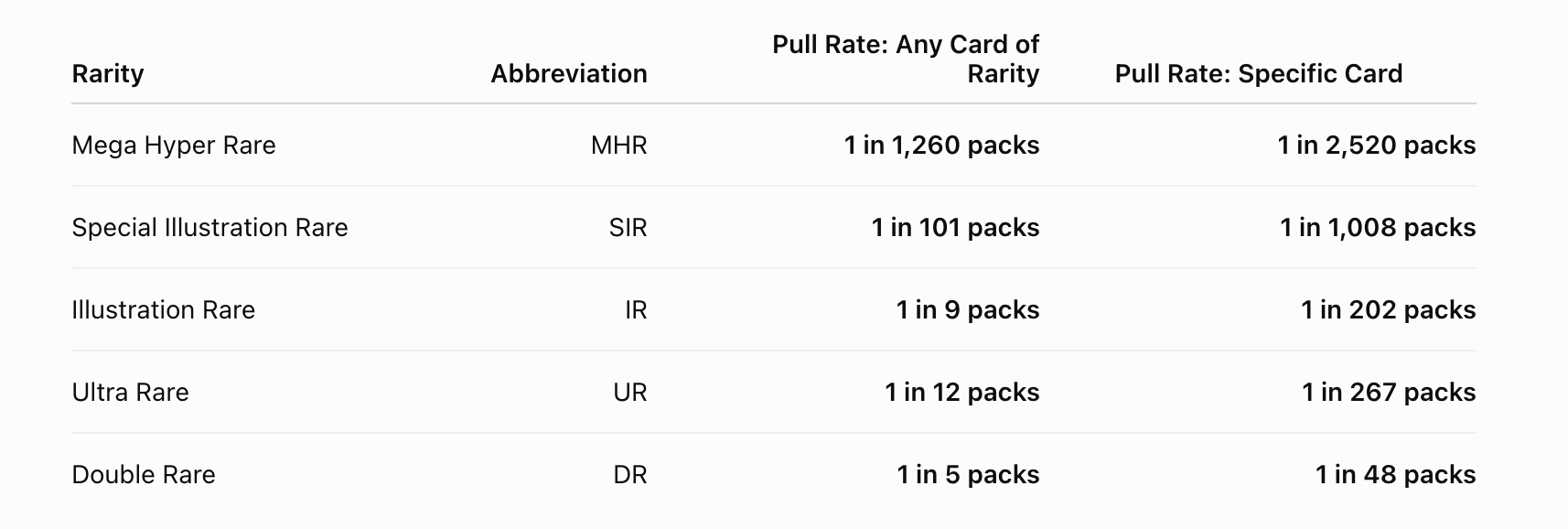
The extreme rarity of the “Mega Hyper Rare” Lucario and Gardevoir didn’t protect them from a steep drop in price since they were first released. The Mega Lucario fell from $605 to $231 and Mega Gardevoir went from $562 to $198. Even though they are exceptionally difficult pulls, they are both down over 60% since September of 2025. An important lesson in Pokémon TCG, the pull rates will tell you something about the long term supply and graded populations, but they don’t always tell you if the card has the correct value in the market.
PSA Population & Gem Rates
Let’s take a look at the Pop Report and Gem Rates for the top cards in the set. The first thing that sticks out is the ridiculously low gem rates for the Mega Hyper Rares. The Mega Lucario is only assigned a PSA 10 grade 27% of the time and the Mega Gardevoir only 22.4% of the time.
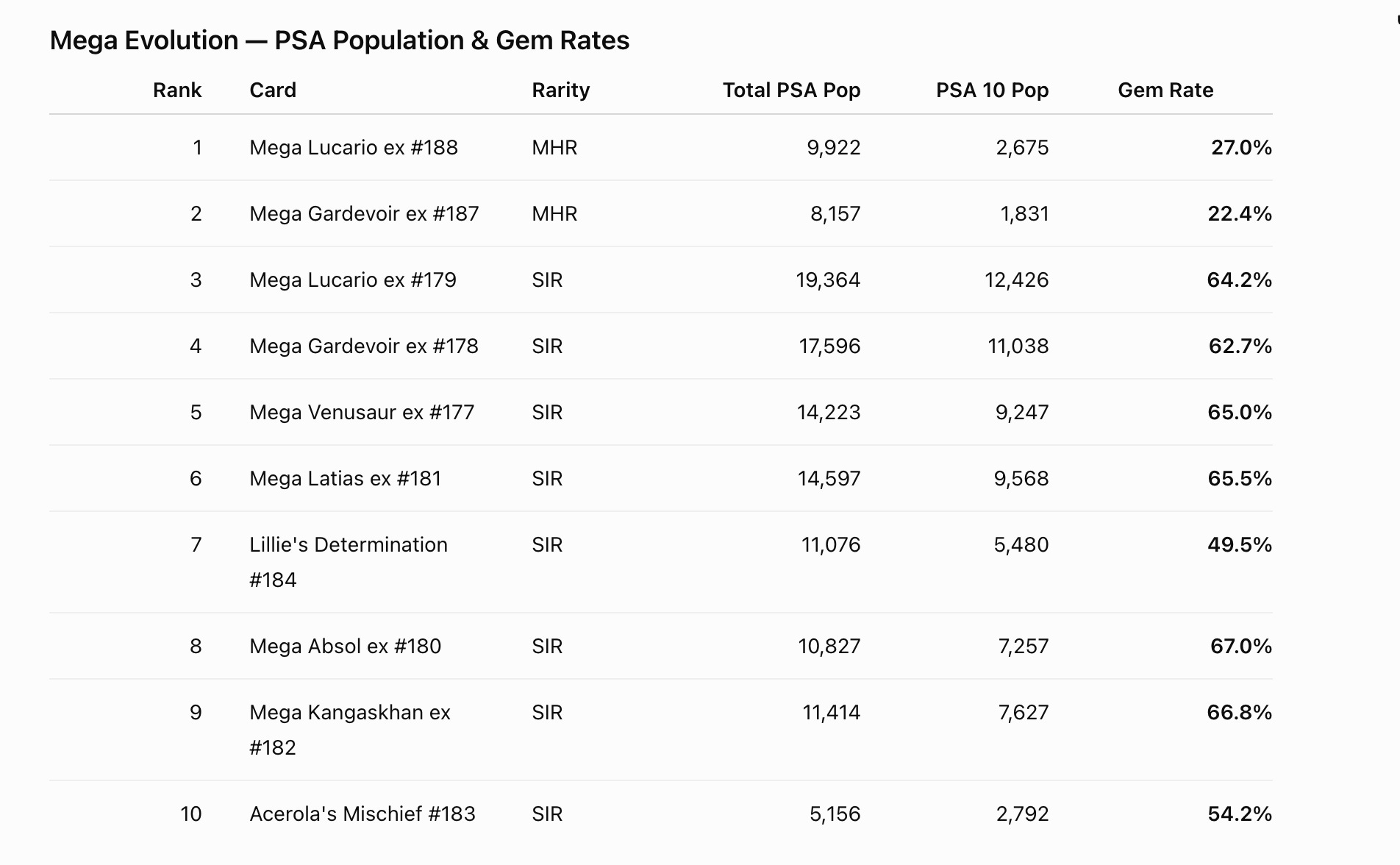
The GEM rates for the Mega Hyper Rares are low, real low. I tried to research what the common issues were to cause the grading to be so difficult. The gold etching on these cards is new. Was it problems with the gold or something else like centering or cut quality? English cards are notorious for quality control issues compared to their Japanese counterparts which typically gem at a very high rate.
The gold treatment itself seems like it could be an issue. I used the Japanese versions as a control. Japanese cards typically don’t have the centering and corner issues that often occur in English printed cards. Their quality control in Japan is second to none.
However, the same pattern does exist in the Japanese sets, although it’s not as severe. The Mega Brave Mega Ultra Rares currently have a gem rate of 53% compared to 78% for the set overall. For Mega Symphonia, it’s 46% for the Mega Ultra Rares vs. 82% for the set. The English printed Mega Hyper Rares are gemming at roughly half the rate of their Japanese counterparts. This suggests that gold-etching itself creates grading difficulties, while the typical English production quality compounds the problem.
From what I can gather, there are centering issues on the English prints. Collector posts repeatedly show images of Lucario and Gardevoir MHRs with visibly poor centering, along with reports of surface imperfections and print lines.
Where Mega Evolution Stands Now
It’s been almost a year since the set was released and we know considerably more about it today than when it first hit the shelves. The initial hype premium has largely disappeared and all of the current Top 10 cards are trading considerably below their early prices. The Mega Hyper Rares are exceptionally difficult to pull and the PSA pop reports show they are also exceptionally difficult to grade.
The most important point I can emphasize is that scarcity and value are not the same thing. Mega Lucario and Mega Gardevoir are a one in 1,260 pack pull, yet the raw value of the cards has dropped by more than 60%. That’s why I stress waiting. Waiting gives you information you don’t have when a set first launches. How much of the initial hype survived? How big did the population grow? Does a card’s rarity translate into real value appreciation?
In my experience, base sets in modern Pokémon eras haven’t typically performed well from a price appreciation standpoint. The biggest sets tend to be the ones with an unusually strong chase card lineup, a major theme, or Pokémon characters that attract the highest collector demand. Mega Evolution doesn’t really have that advantage. Lucario, Gardevoir and Latias all have legitimate collector followings, but the set is missing most of the hobby's biggest demand drivers. There is no Pikachu, Charizard, Mewtwo, or Eevee to drive the set’s popularity. That doesn’t mean Mega Evolution is a bad set, I like some of the chase cards. But I’m not sure if the rarity alone will make these cards major long-term winners.
That’s it for Part 1. Part 2 of this article for paid subscribers will be dropping later this week. I’ll look at replacement cost calculations, whether it makes sense to grade or buy, liquidity, current entry points, and finally rank the PSA 10s I’m actually putting money into.