

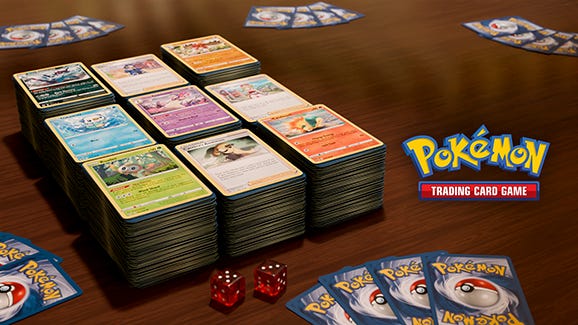
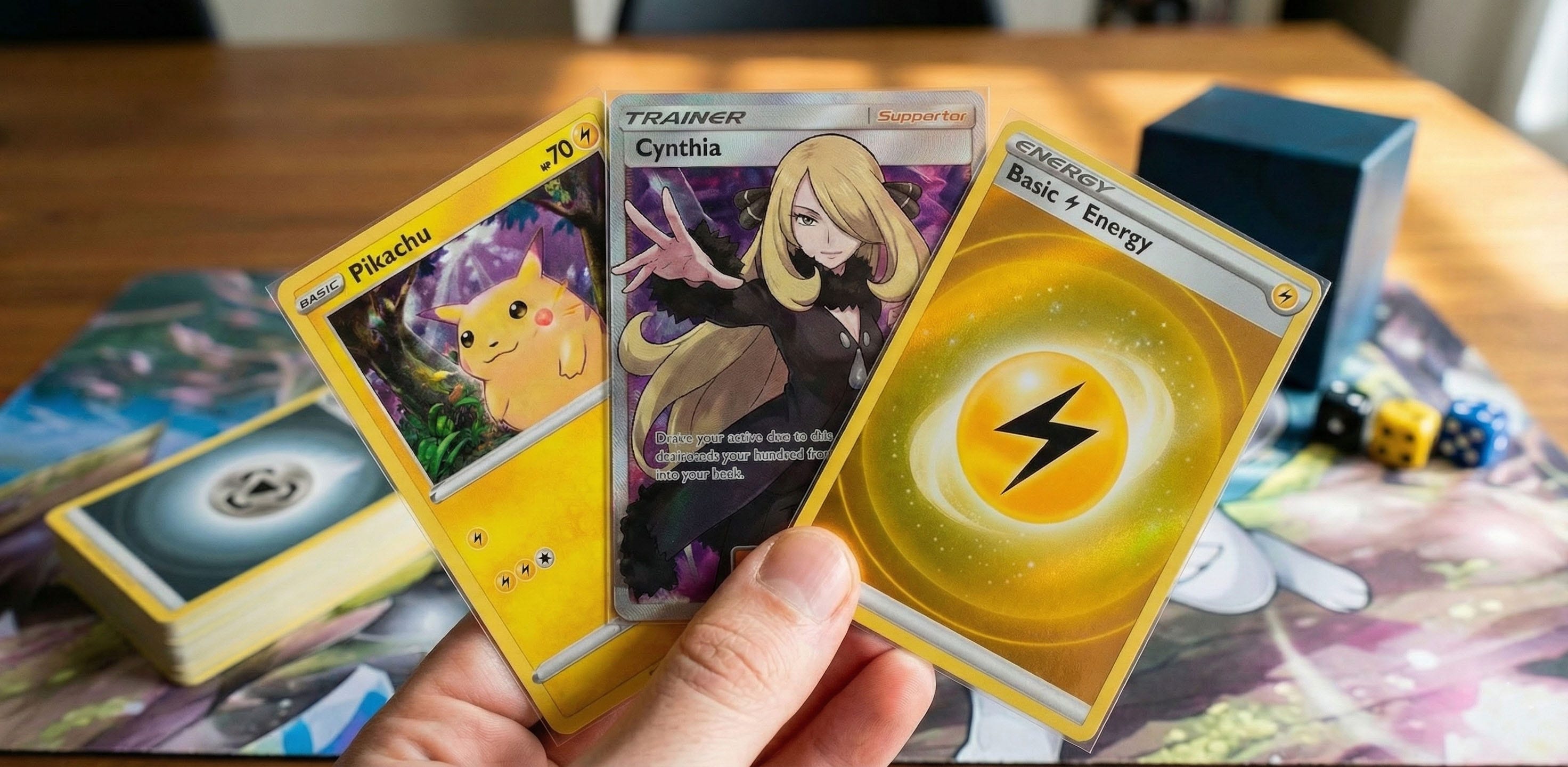
If you’ve only heard “Pokémon cards” as a phrase, here’s a simple breakdown of the card game: the Pokémon Trading Card Game (TCG) is a tabletop game where two players build decks of cards and battle. Each deck is a mix of Pokémon (the creatures that fight), Trainers (cards that help you draw, search, heal, etc.), and Energy (the fuel that lets Pokémon use their attacks). You win by taking all of your Prize cards—think of them as your “points to collect”—or by leaving your opponent with no Pokémon left to fight. That’s it. Everything else is details.
What’s a Deck?
A deck is your collection of exactly 60 cards (no more, no less). You shuffle it at the start of a game and draw from it. A good beginner deck has:
About 15-20 Pokémon cards (your fighters).
30-35 Trainer cards (helpers and tools).
10-15 Energy cards (power for attacks).
Decks are themed around Pokémon types (like Fire or Water) or your favorite Pokémon. For Beginners: You can buy a starter deck or Battle Academy box (~$20)—it’s ready-to-play right out of the box!
The three types of cards you’ll see
1) Pokémon cards (the fighters)
Each Pokémon card shows the creature’s name, HP (hit points), type (Fire, Water, etc.), and one or more attacks. Many Pokémon evolve—you start with a Basic Pokémon and can play Stage 1 and Stage 2 versions on top of it to make it stronger.
You’ll also see era labels on some Pokémon (like ex, GX, V, VMAX, VSTAR). Those are just different generations’ “power” cards—cool, flashy versions that often come with special abilities.
2) Trainer cards (the helpers)
Trainer cards make your deck work.
Items are quick one-time effects (search your deck, switch Pokémon, etc.).
Supporters are stronger effects you can usually play once per turn (big draw/search).
Stadiums are cards that sit in play and change the “arena” for both players.
3) Energy cards (the fuel)
Attacks cost Energy. Basic Energy (like Fire or Water) match the Pokémon’s type. Special Energy sometimes add a useful bonus (draw, heal, etc.). If you’ve ever played a board game that needs resources to act, Energy is that resource.
How the game is played?
At the start, both players shuffle their 60-card decks, draw 7 cards, put a Basic Pokémon face-down as the Active (and any others on the Bench, up to 5), set 6 “Prize cards” face-down, then flip the Active up; a coin flip decides who goes first.
On your turn you draw 1 card, play Trainer cards to set up, attach 1 Energy for the turn, optionally evolve Pokémon that have been in play since a previous turn, and then attack with your Active Pokémon to try to knock out the opponent’s Active and take a Prize;
First to take all 6 Prizes (or leave the opponent with no Pokémon or no cards to draw) wins.
Turn flow (simple): draw → play Trainers → attach 1 Energy → evolve (if able) → retreat (optional) → attack.
Win conditions: take all 6 Prize cards or opponent has no Pokémon in play or opponent can’t draw at the start of their turn.
That’s it in a nutshell. There are additional strategies and nuances involved, but that’s not necessary for understanding the investment side of Pokemon.
Sets, releases, and rarity
Cards release in sets several times a year. Most sets are “main sets”, but you will also see “special sets” that are only sold in specific products like gift tins or Elite Trainer Boxes. (and typically include Promo cards).
Collectors organize these sets into Eras. An Era typically lasts about 3 years and aligns with the current generation of the Pokémon video games on Nintendo consoles. For example:
Sword & Shield Era (2020–2023): Based on the Switch games.
Scarlet & Violet Era (2023–Present): The current era.
Inside every set, cards appear at different rarity levels. For now just remember this ladder:
Common → Uncommon → Rare → Holo (classic shiny foil) → Ultra/Full Art (big, textured art) → Special art (scene-style showcase) → Secret Rare (numbered past the set’s size, e.g., 205/198).
Rarer cards are harder to pull and tend to be more sought after—but rarity alone doesn’t guarantee value. Character, art, and condition still matter most. We’ll dive deeper into this in future articles.
Formats & “Rotation” (why players care—and what collectors should know)
There are two main ways people play:
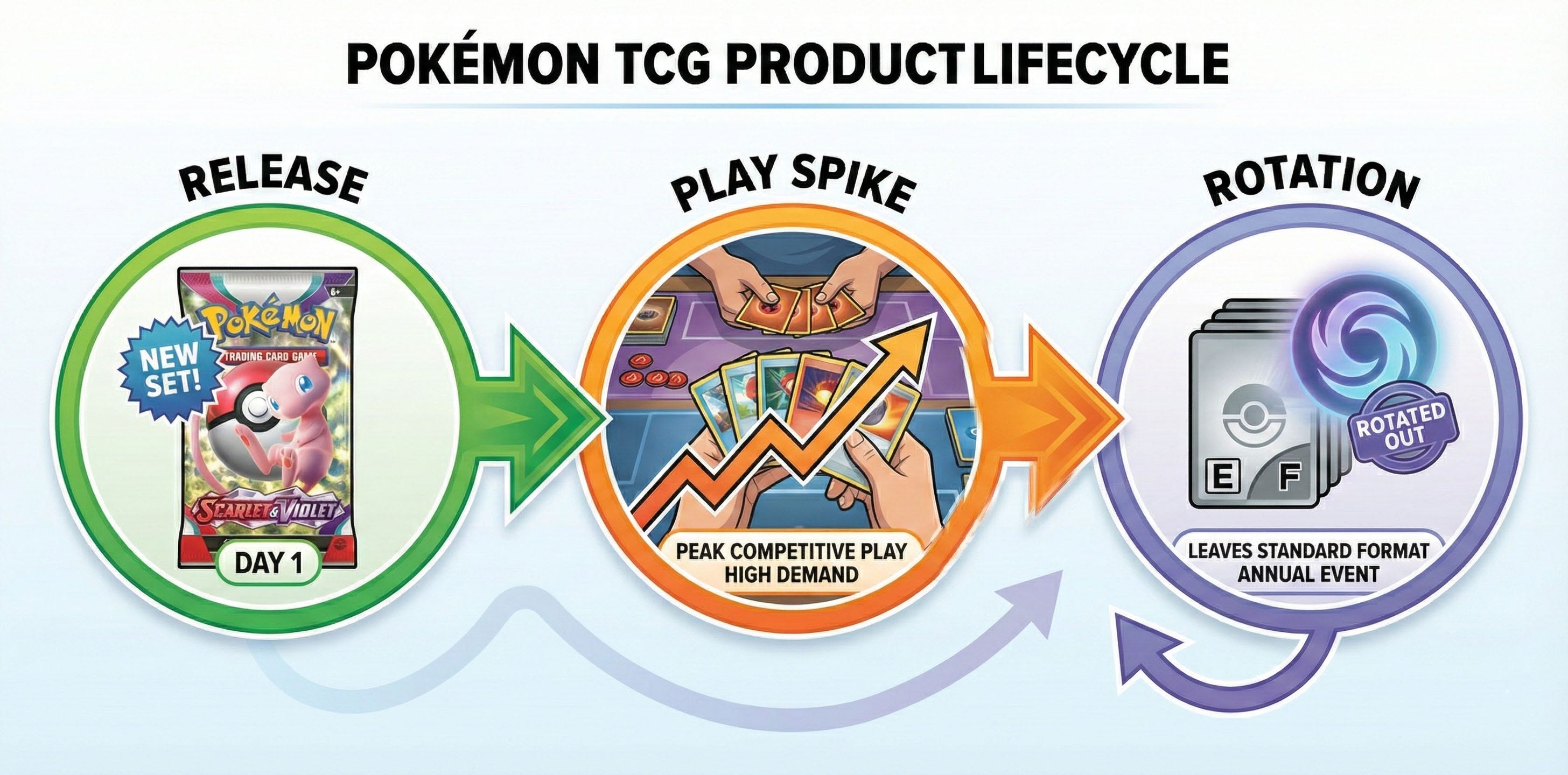
Standard: the main competitive format. Each year, older sets rotate out to keep the game fresh.
Expanded: a larger pool that includes older sets (with its own ban list).
Why this matters to you: when a card becomes a popular competitive staple, prices can spike short-term. When formats rotate or the metagame shifts, those spikes can fade. Long-term collectors focus more on art, characters, rarity, and condition; players care about what wins right now.
The Competitive Scene
While many investors like myself collect the art, there is a massive competitive circuit that drives the game’s popularity (and market).
Locals & Regionals: Players start at local game stores and work their way up to massive Regional Championships, where thousands of players compete in convention centers for cash prizes.
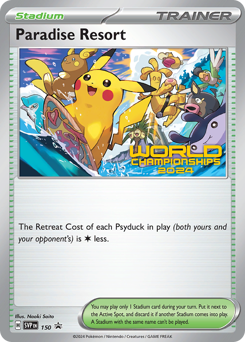
The World Championships: This is the “Super Bowl” of Pokémon. Held once a year in a different major city (like London, Yokohama, or Honolulu), the best players from around the globe compete for hundreds of thousands of dollars.
Why this matters to you: The World Championships are a major market event. The specific decks that win “Worlds” often become part of Pokémon history, and the cards in those decks can see price spikes. Furthermore, exclusive “Promo cards” given only to competitors or staff at these events are among the rarest and most expensive investments in the hobby.
Where to Find More Information
If you want to read the full rulebook, search for specific cards, or find a place to play in person, stick to these official resources from The Pokémon Company International. One final note. While it’s helpful to have some basic understand of the trading card game, it is not a requirement to start collecting or investing in Pokémon cards. Become a paid subscriber to this newsletter, I’ll walk you through everything you need to know to be a profitable collector/investor.
Best for: Latest news, set announcements, and general updates.
This is the central hub for everything Pokémon, including video games and the TCG.
Best for: Learning the game.
Here you can find the official “Learn to Play” tutorial videos and download the complete Official Pokémon TCG Rulebook (PDF). This is the gold standard for resolving any disputes about how a card works.
Best for: Finding local games.
Use this map to find “Pokémon Leagues” (casual weekly meetups) or tournaments at certified local game stores near you. This is the safest way to ensure you are playing in an officially sanctioned environment.
Best for: Researching cards.
This is a searchable database of every card printed. You can type in a Pokémon’s name to see every version of it ever released, which is incredibly helpful for collectors and players alike.
Social Media: Check out our social accounts @thepokeinvestor on X (Twitter) and Instagram for quick updates, new articles, plus early looks at what’s headed to the store. Follow here: X (Twitter) · Instagram (coming soon!) · Shop new arrivals: Store (coming soon).
Disclaimer: The content in this post is provided for informational and entertainment purposes only and reflects the author’s *opinions*. It does not constitute financial, investment, or legal advice, nor a solicitation to buy or sell any asset. Prices, pull rates, and market data are estimates and may change; accuracy is not guaranteed. Pokémon and related trademarks are the property of their respective owners; this publication is not affiliated with or endorsed by Nintendo, or The Pokémon Company.
Copyright Notice: ©ThePokeInvestor. All rights reserved. This material is protected by copyright and may not be copied, reproduced, distributed, or sold without my express written permission.